Wednesday, June 05, 2013

Get Mixed-Up--Twice!


Aloha, Hip Hapa Homeez! Maybe it’s because the Sun is in the sign Gemini this month, but we have two profiles for you. Gemini’s symbols are the Twins, and coincidentally we’re featuring two Hip Hapa Homeez. Both are Ph.D. candidates and both are looking for mixed folks like you to get mixed up in their dissertations. Be sure to click the links below each interview to get in the mix!

Zankhana with her fiancee
First up, Zankhana Sheth, a fourth-year doctoral student in clinical psychology at Wright Institute in Berkeley.
Q: Zankhana, what’s your ethnicity?

A: I was born in India and am Indian American.

Q: How were you brought up?

A: I was not raised in a mixed environment. 

Q: What made you interested in Black/Asian relationships?

A: I’m part of a Black-Indian couple and we’re getting married. I'm in psychology so I did some checking to see if there were any particular experiences shared by many people in similar relationships; and, there were no research studies about the experiences of people of color who interracially marry each other. I hope to learn more through my dissertation and help others to be aware of our experiences as well.

Q: What's the purpose of your study?  

Zankhana engaged
A: I hope through my study that awareness and understanding about interracial couples of color will be increased in general, but I also believe that when couples like ours look for support, couples therapy should be a viable option. However, many therapists know little about our experiences and can find it challenging to work with interracial couples. So, if some people are willing to share some of their experiences, it could really help therapists work with couples better.

Q: How can we help?

A: If you're interested in participating in my study, and live in California, please contact me for further information. To be eligible for this study, you and your spouse must both identify as Asian/Asian American, Black/African American, Latino/Hispanic, Middle Eastern, Multiracial, and/or Native American and have been married at least a year. The study consists of a 1-2 hour in-person interview as well as some background paperwork. All interviewed participants will receive a $20 gift card to Amazon.com for their time and contributions. Contact me at zankhanas.psych@gmail.com for more information and to see if you qualify.  

All right! Next up, is Lisa Giamo, a Ph.D. student in Social Psychology at Simon Fraser University.

Lisa with parents
Q: Lisa, what’s your ethnicity?

A: My mother is Korean, and my father is Sicilian-American.


Nana, Lisa and Mom

Q: How were you brought up?


A:  I was raised in a mixed environment, being exposed to American, Sicilian and Korean cultural values. My Nana (on my father's side) helped raise me, so I was exposed to some traditions from that side. However, since my mother is from Korea, I am more in tune with the language, food and other cultural practices of that side of my family. 


Q: What made you interested in White/Asian relationships?

Lisa and brother
A:  I thought it was completely normal to have one Asian and one White parent, until I started kindergarten and realized that people treated me differently because of the way I looked. Growing up, my younger brother and I were pretty much the only two people of our background in school. As I got older and started meeting other multiracial people, I became interested in how our experiences shape who we are and how we see the world, particularly for those that have multiple racial backgrounds.

Q: What's the purpose of your study?

A: My current research is focused on understanding the experiences of multiracial people and how it influences their identification choices. As scholars, we know very little about the psychological processes of multiracial people and are just starting to build theories and empirical work in that area, since there are some inherent complexities with interracial relationships on the rise and multiracials the fastest growing minority group in North America. Projections indicate that by the year 2050, 1 out of every 5 people in America will claim a multiracial background. Thus, it becomes increasingly important to gain a better understanding of the ways in which we conceptualize race and ethnicity, and how multiracials 'fit' into the current conversations, as well as future implications. 

Lisa with Greenlining Institute colleagues
Q: How can we help?

A:  I’m currently collecting data for my dissertation study examining multiracial identity. If you’re interested in being a part of this research, please use the following link to our survey: 


It would also be appreciated if you could forward this information on to anyone you know that has one White parent and one Asian parent who might be interested in participating. Thanks for your time and consideration.

All right, Hip Hapa Homeez, get your mixed selves mixed up in these awesome causes. 

And, don’t forget to join us at Hip Hapa Homeez on Facebook where we enjoy ongoing discussions about being mixed-race, interracially involved, transracially adopted or crossing cultures. Please also like our Watermelon Sushi and Hapa Teez t-shirt fan pages, too.

BlacKorean Rob Lee in Hapa*Teez
Check out Rob Lee in his BlacKorean tee above, and remember buying a Hapa-Teez helps fund our Watermelon Sushi film.

Wishing you double summer fun, I am

Your Hip Hapa,

Yayoi

Wednesday, May 01, 2013

Spirits Aloha

Anna Malone
Aloha, Hip Hapa Homeez. What’s HAPA-ning? 

One of the most mixed-race locales to reside in the U.S. is Hawai’i. It seems that a lot of folks here are a combo of ethnicities and even if they HAPA-en to be so-called monoracial, they still love to cross cultures. As strong as the East Asian presence is in Hawai’i though, it still remains well, Hawai’ian. Streets are named after indigenous Kanaka Maoli and, anyone who lives here for a length of time will soon learn to say "Kamehameha" with the utmost ease. Kanaka history is powerful, its culture colorful, and the melding locals truly reflect the Aloha Spirit originated by them.

This month, we feature two Hip Hapa Homeez both abundantly infused with the Aloha Spirit.

First, meet Anna Malone, a Japanese national who settled in Honolulu after attending school on the mainland. The mother of a blasian boy, Anna shares her story—the shorter version--here with you.

Q: Anna-san, where are you from, and how did you end up living in America?

A: I’m from Osaka City in Osaka Prefecture. I first came to the States when I was 19, graduated college, went back to Japan for 3 years, came back to the States, and married. It’s been about 20 years since I came to the U.S. for the first time!

feeling the Aloha Spirit...
Q: What are some of the differences between living in Japan and the U.S.?

A: In Japan, people tend to gather as group. So, they think of themselves as a group or unit. But in the U.S., people think of themselves as individuals.

In the U.S., I need to think about my race, but in Japan I don't need to. I’ve experienced racism on the mainland, but not in Hawai’i since the majority here is Asian.

Q: What have been the biggest cultural issues that you had to overcome living in America?

A: Racism. In the American town where I lived about 20 years ago, there was only one Chinese restaurant! Kids there met an Asian (me) in person for the first time. That’s how closed off that place was.

Another big cultural issue is learning English.

Q: What do you miss most about not living in Japan?

A: The food, but I’m lucky enough to get some ingredients to make Japanese meals in Hawai’i. So I’m not missing that much.

Mr. Sag
Q: What's it like for you to have a son, Sag (pronounced Saj), whose father is African American?

A: A long time ago I went to a black barbershop with my son, and I was accepted. But when I visited there by myself for the first time, they just looked at me like, "you came here for what?"

But mixed races are very common now, and I think it makes racial issues less important than a few decades ago. It’s making opening racial doors easier. 

Q: Do you think it's better to raise Sag in the U.S. or Japan?

A: Definitely in the U.S. Japan is not as open-minded as it should be--only in major cities, I think.

Sag feeling the Spirit
Q: In your opinion, what's the future look like for mixed-race people like Sag?

A: I think more people will be mixed-raced in the future and it will be harder to find single-raced people, especially in the States. In Hawai’i, I have heard of people mixed with as many as 9 races, and 2 to 3 race mixes is very common here. My son is mixed with 4 races.

Mahalo nui loa, Anna-san. 

Next up, Hip Hapa Homeez, please reacquaint yourself with Traion Le whom we featured here some time ago.


Below, Traion aka Traika tells her story in her own words:

Traion aka Traika
Aloha, Yayoi and readers!

It's your new Hawaiiana friend, Traika, from Honolulu on the island of Oahu, aka "The Gathering Place".

I'm a mixed-raced hapa lady (African-American, Irish, Native American) originally from the East Coast (Northern Virginia), and I'm a 9-year resident of Oahu. I love Hawai’i! I like the local people, and the ono grindz! I like being one with paradise. Feeling the island breeze. Cooling off in the Pacific Ocean. Smelling the sweet red, pink, yellow hibiscus flowers and, let's not forget, the pretty plumeria flowers. And the tradition of wearing flowers tucked behind your ears for the extra beautiful island flair! Tasting the island foods; Leonard's Malasada's, and all kine local cuisine. Favorites are the Japanese steakhouses, Tanaka's and Kobe's. Also, Northshore's Giovanni's shrimp and rice plate, and townside of Oahu's Pearl's Korean BBQ. Mmm, lish!

Hawai'ian hibiscus
As a 45 year-old mixed-race hapa lady, I've always loved Asian culture. I love all god's children, yes, however, there's a weakness for Asian men! Ha ha. Yep, that's right! I've dated and loved Asian guys since I was young. Watching my first Bruce Lee film, Fists of Fury, I was a goner; crushin' on Bruce. He did it for me! In addition, I was raised in the melting pot nation--the metropolitan area of Washington, D.C. "Chocolate City". I had friends of every foreign nationality imaginable. So enriching!

LMT'ing
My profession is Licensed Massage Therapist (LMT) for 13 years. I've also enjoyed modeling and acting gigs, but my greatest passion now is writing. Please check out my info below.

Living in Hawai’i inspired me to write and publish books. My latest book, Destiny, is an AMBW (Asian Man Black Woman) true story. I believe all of you interracial couples, AMBW or other mixed couples out there, will relate to what I bring to a 6x9 250-page documentary.

Hawai'ian style toenails...
Destiny by Traika Le (2013)
"A coming-of-age, true story. In 1975, a young Vietnamese refugee boy flees Saigon and the war. In 1985, he meets his unrequited forbidden love, a Southern, African American girl. His enemies and family warn him to keep his distance from her. He joins a crime organization for fast money, hoping to live the American Dream and win her heart."

Look for your copy of Destiny, a story of forbidden interracial love and redemption. Watch for it on Amazon.com July/August 2013!

local girl...
Thank you for reading! All the best and god bless!


Please frequent my sites:


AMBW:
www.amazon.com (search Traika Le)-Book, Faith Your Fears
big Aloha kiss from Traika...

Mahalo! Thank you!

Traika

Thank you, Traika. Hey, Hip Hapa Homeez, for a clarification of the word hapa, check out our Hip Hapa Homeez group page on Facebook. Send us a request for membership and you can join in discussions about being mixed-race, transracially adopted, interracially involved, or just crossing cultures. Remember, we have a Watermelon Sushi film and fan page, and our Hapa Teez t-shirts fund our projects.

Until we meet again, aloha nui loa from

Your Hip Hapa,

Yayoi

PS Lisa Giamo is conducting research on mixed Asian/Caucasian people as part of her dissertation at Simon Fraser University. Check it out:


Wednesday, April 03, 2013

Yanks For The Memories: Cross-Cultural Filmmaking With DeYung

Aloha, Hip Hapa Homeez!

If you were allowed to share just one memory with the world, what would that be? Would it be something personal, like your feelings about that precious pup you grew up with? Or, would it be something more worldly—like that high school graduation trip abroad? Unless, of course, you partied too hardy and would rather not remember that crazy night in Paris. What happens in Paris, stays in…

DeYung at NYU
Memories, as we know, can be both good and bad. But as we get older, we seem to revel in remembrance of that one happy moment or the experience of several magical moments. Even though we tend to embellish them the longer we reflect on them, the important thing is that we have them. In fact, memories are what seems to sustain us as humans.

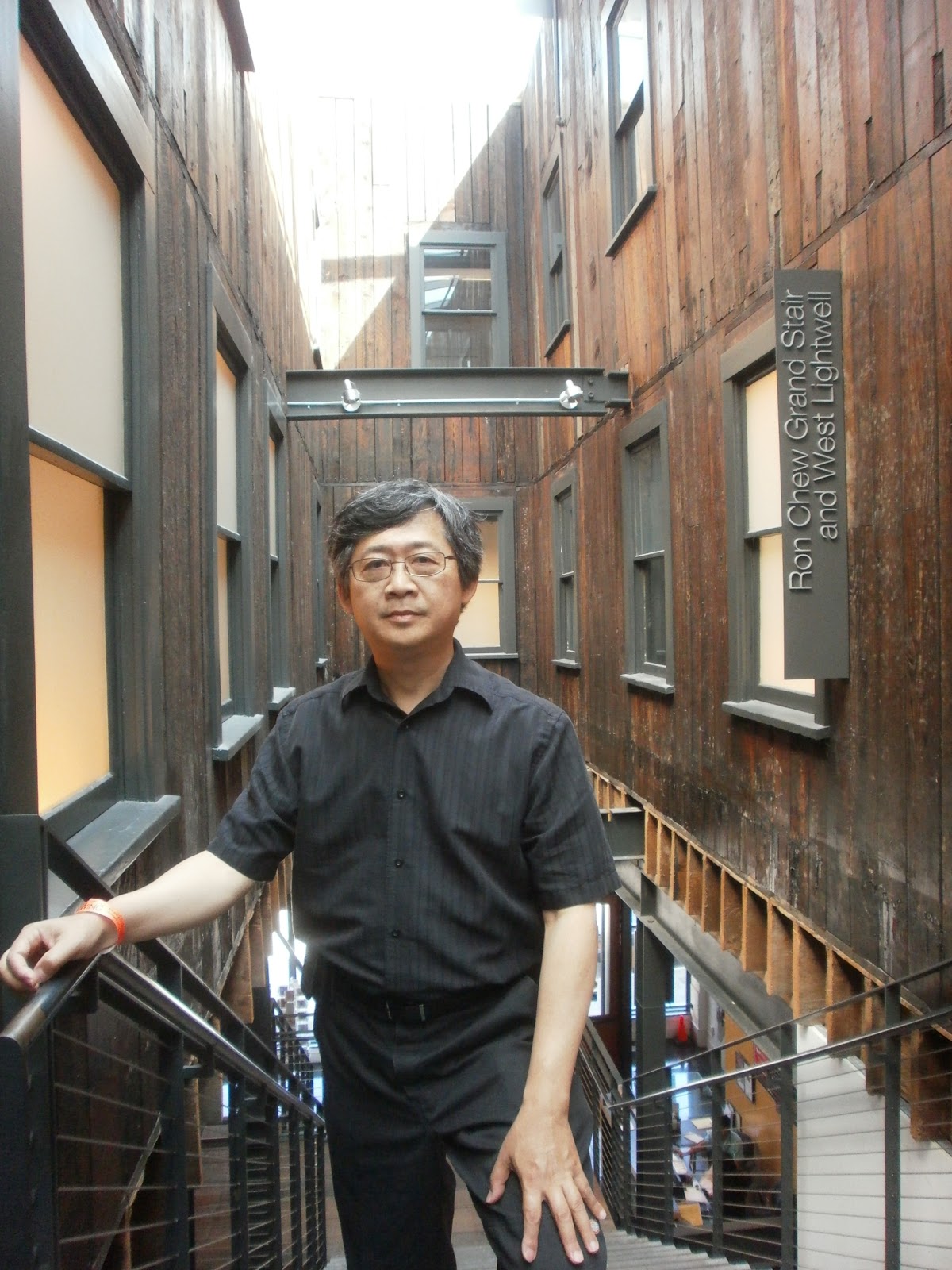
This month’s featured Hip Hapa Homee is Taiwan-born filmmaker, DeYung Chou, who moved to New York City to attend NYU. Currently living in the Pacific Northwest, he makes documentaries of the elderly sharing their stories through vivid memories. Determined to record the older generation before they leave us, DeYung has made it his mission to film and share their memories with the world.

Q: DeYung, what motivated you to move to the U.S.?

A:  I got my Green Card and lost my dear mother both in 2007. Eventually, I came here in 2010 in order to start a new life and to take care of my health.  

Q: What was it like attending film school in America?

A: I enjoyed most of the courses that I took as well as the teachers. One of them always sat on top of the table and chewed gum while he was teaching, while the other always had us watch a movie before and after he made a few comments. My overall feeling about NYU film school was freedom and wisdom. You could be as free as you wanted yet you should be making yourself a wise student at the same time.

Q: What is the Memory Community Project?

A: Memory Community is a non-profit organization whose project “Memory Community Movie/Memoir” is making short films of elderly people, regardless of races and languages, and the most memorable story of their lives. 

DeYung in the Pacific Northwest
Q: Are there any differences between your American-born subjects and those who aren’t originally from here? For instance, is one group more willing to talk to you or to be featured on film?

A: Interestingly, up to now, my subjects are mostly American-born and English speakers. As an Asian myself, I naturally look forward to serving Asian communities. I did have a few Asian subjects who were originally from Taiwan, China and Vietnam. They were willing to talk to me and to be featured in a film. I’m confident that everyone will appreciate my project if they have access to understanding it.

Q: What are some of the best stories you've heard so far?

A: For my personal interest, it has to be the story that Robert Lee Smith, a Kentucky-born U.S. Air Force veteran, shared in his film. He spent many good years serving his country in my home country. He even lived in the city where I was born and grew up. His story makes me nostalgic. 

Q: Any future plans?

A: One is to bring the project to all age groups. Another is to showcase films made by people around the world on my website. The third is to be able to hire a professional staff.

Q: How can Hip Hapa Homeez help?

A: Since 2012, I have heard from some locals who want to volunteer for my organization. I appreciate that greatly since I’m still pretty much of a newcomer here in Washington State. Donations of money are probably more needed at this point. For instance, I haven’t been able to cover the application fee for the necessary 501(c) (3) status for the organization. Media coverage can effectively help, too.

Okay, got that Hip Hapa Homeez? Let’s support this amazing project that brings our elderly to the forefront. Thank you, DeYung.

And, here’s the link to former yank Robert Lee Smith’s story, second video down:


born in the wrong month

Hey, all you Yayoi’s who celebrated birthdays last month (Yayoi can mean early Spring sky in kanji), I send you an omedetto gozaimashita and congratulations. If you’ve been with me for awhile, then you may recall that my artistic mother named me Yayoi in spite of her Japanese doctor scolding her about doing so too late in the season. Every year, I just have to wait it out until May as I check out Yayoi’s all over the world cavorting in cherry blossom heaven.


Cassie
Julia
Remember to like Watermelon Sushi and Hapa*Teez on Facebook. We have vid clips of Hapa*Teez on YouTube and you can also buy one at Café Press. For stimulating discussion about being mixed, interracially involved, transracially adopted, or living the cross-cultural life, join our Hip Hapa Homeez group on Facebook.


Until we meet in May, I am and will always be

Your Hip Hapa,

Yayoi


Wednesday, March 06, 2013

Sardonic Sister: Everyone's Favorite Sibling


our sardonic sister...

Aloha nui loa, Hip Hapa Homeez. With daylight savings time just around the corner, it feels like spring is on her way. Even though Your Hip Hapa is looking forward to the sense of renewal and rebirth this time of year brings, I find myself still attached to the past.

Like, remembering the first handful of people who contacted me shortly after I re-launched this blog in 2008—one of them being Renee Tecco, this month’s featured Hip Hapa Homee. You may know Renee because of her writing and by her “stage” name Sardonic Sister. Well, here's everyone's favorite sibling:

Q: Renee, how did your parents meet?

A: Both of my parents are African American and were a part of the great migration of blacks from the south to the north (my father after he served in WWII and my mother in the late 50’s). They met through my cousin who was dating my mother's close friend.

Q: Where were you brought up?

A: My father left when I was young and I was raised in the projects--all African American, of course. It was the early 70’s and, even in Cincinnati, they were just beginning to integrate the schools. My first memory of realizing things were different for us was when I participated with my mother and older brothers in a walk to help provide busing from our area to the local school. The school was predominantly white. It wasn't until I went to junior high that I encountered other ethnicities. 

Jim and Renee
Q: How did you meet your husband, and what are some challenges of an interracial relationship? 

A: I met my husband nearly 10 years ago in a Yahoo! group that discusses Asian American-African American issues. He’s Korean American and was adopted into a white family when he was a baby.

There have been no challenges to our being an interracial couple; most of our disagreements are cultural issues that stem from me being a Cincinnatian and his being a Clevelander.

kids J2 and Mimi, with Filmore
Q: In what ways did you two help your children shape their identities?

A: The children are grown now, but we tried to raise them with the knowledge that self-identifying and connecting with community is more important than the external acceptance of strangers. 

My daughter is African American and my (step)son is Korean-African American. It's interesting trying to see race through their eyes. My son has black step-siblings with his mother so he self identifies as blasian when people often ask him, "What are you?"

My daughter has half-white siblings through her father, although she doesn't get to interact with them much since they live on the West Coast. Of course, she self identifies as black, but I have often pondered that my relationship to blackness isn't the same as my kids’. 

Ejiro in Hapa*Teez
Q: With all of your passionate pursuits, do you consider yourself an activist?

A: I don't consider myself an activist, but more of a person who is really, really curious (sometimes passionately so) about almost everything. With my blog, I want to connect people to ideas and an openness of understanding. I blog about LGBTQ because a lot of my friends are in that community, while at the same time I can relate to those who are wary of them because I was once that way, too. 

I blog about being black and trying to navigate the rise of other minorities, whether it's them surpassing us in population or in the workplace. 

I blog about being nerdy; I love science and I am a trivia fanatic (I think they made the magazine Mental Floss just for me). 

I blog about music; I am a black rock music fan, but I am also a KPop fan. I know, they seem diametrically opposed, but when I am out on a jog it all blends well with the electronic/dance music I am undoubtedly listening to.

Cassie in Hapa*Teez
Julia in Hapa*Teez
Q: Why do you call yourself “Sardonic Sister”?

A: I came up with the name Sardonic Sister for my main blog because I felt after the age of 35 I had graduated from being sarcastic to mordant. Plus, it has a better ring than Pragma-Sis, which people probably wouldn't get.

Q: What’s in the future? Any final thoughts?

A: For the Sardonic Sistah blog, besides continuing to look at race, music, and science from an Ohioan perspective, I also plan to update more on my family and fiction blog.

Eva in Hapa*Teez
Each person relates to the world in a different way, but in minority communities we soften out the edges to give the illusion of unity. For the last 20 years or so, the definition of who is black and even who gets to be black has been getting kicked around among laymen and scholars alike. For a brief moment, it seemed to restrict and looked as if black youth culture was obscuring it. But looking at my kids and their generation, it seems as if they are figuring it out and strengthening it. Which is not to say that sometimes they don't feel isolated from some African Americans or some Asian Americans, but they have learned to move on and find compatible friends/communities where they can express themselves and grow. In regards to race, we tried to get across to them that in life they will run across people who may want to pull your race/gender card (you aren't acting black enough, Asian enough, masculine enough, feminine enough), but the only person's opinion that matters is their own.

And mine, of course.

Just kidding. 

As a writer, I have always been interested in reaching out to marginalized voices or older voices to have them heard. I am generally an introverted person. So, I am not my favorite subject, but people in general fascinate me and I have never shied away from an interview or conversation with people from all walks of life. Under my maiden name, I have written freelance for The Cincinnati Herald (a local black newspaper) and worked with the Cincinnati Black Theatre Company (CBTC). With CBTC, I have done public relations as well as written and adapted a few plays. 

Carol in Hapa*Teez
This year with the Sardonic Sister blog, I want to focus on education. When my daughter was young and I was a single mother, I was always looking for low-cost ways to help supplement her education. Some things I got her into, others I missed out on. A lot of people gave praise and criticism to Amy Chua for her book (and mostly her attitude) about being a “Tiger Mom”. I realize that a lot of African American women in poverty are also “Tiger Mothers”--we just don't have the resources or we don't know about certain programs because no one is telling us. I know because I was one of those mothers who knew just enough to search out information and not rely on my local school.

The feature on my blog will run biweekly and can be located by searching the tag “The Urban Mama's Guide to Educating Children”.  I have already written two articles on the subject and more are forthcoming this year.

Robert in Hapa*Teez
Mahalo nui loa, Renee. You are one busy and prolific Sardonic Sister. Your Hip Hapa is sooo hapa to have known you from the start.

Here’s a link to an article that cited Renee’s story for a story written in The Cincinnati Herald.


And, here are the Sardonic Sister’s blog links again:


Just like Renee, you Hip Hapa Homeez can also get involved in the multi-culti movement. Get active by: liking Watermelon Sushi and Hapa*Teez on Facebook. Join our discussions on the Hip Hapa Homeez group page on Facebook. Check out our vid clip of Hapa*Teez on YouTube, and buy one at Café Press.

Until spring arrives for real, and beyond, I will always be

Your Hip Hapa

Yayoi