Showing posts with label Kyu Sakamoto. Show all posts

Wednesday, May 04, 2011

Hapa Japan Jams With Jero-san And Ms. Anime Eyes!


Hey, Hip Hapa Homeez!

Mad props to Duncan Ryuken Williams and his helpers for organizing the Hapa Japan Conference in Berkeley last month. No doubt, it was one of the best events Your Hip Hapa has ever attended. Shout-outs to all involved.

At the Berkeley campus on Friday and Saturday, the audience listened to various panels presenting on everything from Okinawan-Black mixies and the U.S. military to Japanese-Indigenous of Australia.

Jero-san gets an award while Duncan speaks and Your Hip Hapa looks on.
Photo courtesy of Edward Y. Sumoto.
Then, on Friday night, Duncan presented the New Vision Award to Japan enka singer and superstar Jero-san! Afterwards, we all had the chance to speak to, and take pix with, Jero-san. If you’re a long-time WSW blog reader, then you know how much Your Hip Hapa has admired this young man from Pennsylvania whose mother is Japanese and Black.

Later that evening, Jero-san performed a mini concert of five songs ending with a sing-along of Kyu Sakamoto’s Ue O Muite Arukou. What a bittersweet moment for those of us who remember “Kyu-chan” and his tragic death in 1985—20 some years after his Japanese language song made it to #1 in the U.S.!

At Saturday night's party; shortly after Jero-san handed the klutz some napkins.
Thanks for the snap, Fredrick Cloyd!
Following Saturday’s panel discussion, we headed to San Francisco’s Nihonmachi (J-town) for a party where Jero-san appeared with his manager. What a perfect gentleman! When Your Hip Hapa related how she had clumsily spilled sake on her hand, Jero-san immediately grabbed napkins from the table behind him and handed them to her.

Later that night, someone yelled, “All the Blackanese in the room stand with Jero-san for a picture!” What an incredible moment for all of us AfroAsians to gather around the man who crosses cultures with his incredible music. 

Blackanese in da houze with Jero-san (in red shoes) and Your Hip Hapa (on his left).
Photo courtesy of Jayson Carpenter  on behalf of Marcia Lise and The Hafu Project. 
And, of course, Your Hip Hapa talked to Jero-san about appearing in Watermelon Sushi. Wouldn’t you love to see him playing a role in the film? So would we!

So many special friendships were forged at the Hapa Japan Conference. In some cases, Your Hip Hapa finally met people for the first time that she’d been in touch with through cyberspace for decades—including painter and activist Lenore Chinn, after 12 years.

You’ll be reading about some of these fabulous folks here, over the next few months. This month, our guest is Athena Asklipiadis of Mixed Marrow. As she posed for a photo, I exclaimed, “You have anime eyes!” to which Athena replied, “Someone else told me that, too.” What do you think? Doesn’t she look as sweet and innocent as an anime character? Here's her link: http://www.mixedmarrow.org

Athena, sitting on right, with Mixed Marrow volunteers.
Q: Athena, how did your parents meet?

A: My father is Greek, Italian, Armenian and Egyptian born in Cairo. My mom is Japanese-American born in California. They met in Athens at a Japanese restaurant. At the time, my mom was a tourist and was curious about Japanese cuisine in Greece, and my father worked there.

Q: How did you grow up?

A: I grew up in a primarily African American and Latino community in South LA in the Crenshaw area. There, I was a very, very rare breed--the only person of my kind that I knew of in my whole neighborhood. I was called everything you could think of: "Chinese girl", "China" in Spanish, "white girl", and "flat faced" just to name a few. Being so different from people who lived near me and because the schools in my area were famous for shootings and gang activity, my parents sent me to school in a more diverse and safer neighborhood. But the "feeling different" thing didn't really end. I was still the minority because there weren't many mixed kids in the primarily white schools I attended. I suppose if I had siblings, it would have been a little easier having others like me around. But with time, race became less of an issue as my classmates grew up and got more mature; so, by high school it was not as much of a problem.

Q: What inspired you to create Mixed Marrow?

A: In 2007, my aunt Esther Matsuguma passed away with lymphoma and it really hit me hard. I was close to her and it was so difficult to see her suffering first-hand. After a year of coping with her loss, I was randomly approached at a Japanese festival in Los Angeles by a bone marrow donor recruiter. They asked if I was half Japanese and I said I was. Then, they told me about Krissy Kobata, a local girl my age who was in need of a bone marrow match. Her family was there signing up donors and it touched me that they were so diligent and hopeful that they would be able to save her. It made me think back to my aunt and her struggle. I had to sign up for her and for Krissy, so I did. After some thought, I decided I wanted to get more involved and volunteer with the recruitment organization that signed me up, Asians for Miracle Marrow Matches (A3M). I thought that if I could have done anything to save my aunt, I would have, but a transplant was not an option she was given. So for about one year, I volunteered with A3M. I did drives to recruit new donors, but in the process I realized our community--the mixed community--did not have this cause on its radar. I had been actively working with sites like Eurasian Nation, Addicted to Race and We Are Hapa, and I had never seen it mentioned on a large scale. I wanted to change that. So, with the help of A3M and the National Marrow Donor Program, Be The Match, I launched Mixed Marrow in 2009.

Q: What are some reasons that someone would need a bone marrow transplant?

A: Patients facing blood diseases like leukemia may be candidates for a transplant for either/or marrow or cord blood. Recent medical news has even shown positive results from stem cells helping with diseases like MS, heart disease, diabetes and even AIDS. These findings are happening every day and stem cell donation is still relatively new. That said, it’s not determined what the long-term effects are and if a complete cure can be achieved with the help of new stem cells.

Q: What are some misconceptions about donating marrow?

A: For one, there are two ways to donate; one similar to blood donation is done through the arm called PBSC donation and, the other is still done through the hipbone by needle. For the marrow donation through the hipbone--not spine like people think--a needle is used and you are not cut open surgically. You are also under anesthesia and do not feel the procedure. Also, marrow regenerates and you do not lose anything permanently.  

When it comes to cord blood donation, people hear "stem cells" and automatically think of embryonic stem cells and abortion. Cord blood stem cells come from the umbilical cord, which is usually disposed of 95% of the time. The cord blood donation process has no effect on mother or baby.

Q: One stat on your website indicates that a mixed-race person might have only 1 in 4 chances of being a match for a sibling. Does that mean mixed-race people are so different from each other even when they're related?

A: Any patient has a 1 in 4 chance of matching a sibling regardless of race. When it comes to mixed-race patients, the odds are lower because there are simply not enough donor matches in the registry. Part of the reason is because the majority of multiethnic people are under the age of 18 and, therefore, too young to donate marrow. The other reason is that there is lack of knowledge within our community and minority communities about the dire need for donors and what role ethnicity plays in matching.

Q: What are some activities your organization is involved with to bring attention to your cause?

A: Mixed Marrow hosts drives at ethnic festivals, book and art exhibits, museums, college campuses, and at various churches and businesses. Some past events include Kip Fulbeck's Exhibit openings, Loving Day's flagship event in New York, the Mixed Roots Film and Literary Festival, the Critical Mixed Race Studies Conference at DePaul, Harvard's So What Are You Anyways? Conference and Berkeley's Hapa Japan Conference. Besides onsite drives, Mixed Marrow also works to educate the public through awareness campaigns via film, radio, internet, and print media. Most recently, Mixed Marrow has teamed up with filmmaker Jeff Chiba Stearns to produce a feature-length documentary exploring the need for more diverse donors. The film is set to release in 2013.

Thank you, Ms. Anime Eyes!

Hey, Hip Hapa Homeez, for whatever reason, Facebook can’t seem to leave well enough alone. So, our Hip Hapa Homeez Group is either going to get updated or archived. Remember, this is where you can post and read info about multiethnic news. As a new Group, we’ll have to re-add everyone to its membership. If we’re archived, I believe that won’t be possible. So, please become a member when the updated version becomes available. Also, we’ve created a Facebook Fan page for Hapa*Teez t-shirts since the Watermelon Sushi film website is being redesigned. If you’ve made a Hapa*Teez purchase, please drop us a line so we can list your name correctly for rear crawl credits and mention you on the new website! Check out Hapa*Teez on CafĂ© Press so you can look as lovely as Curly Like Me author Teri LaFlesh does in her t-shirt below. You can also “like” our Watermelon Sushi Fan page, and follow us on Twitter.
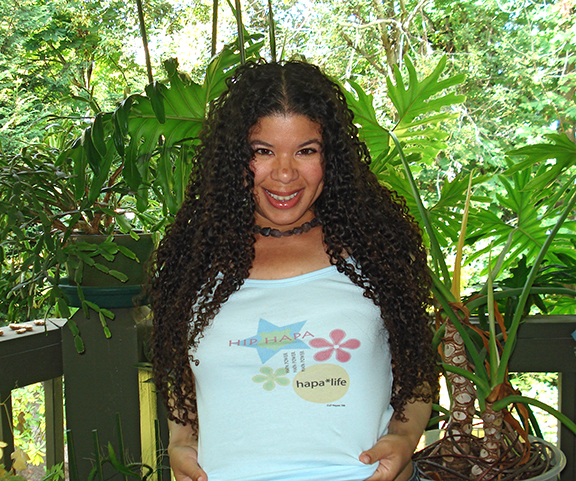

Until next time, I will always be…

Your Hip Hapa,
Yayoi

Wednesday, June 30, 2010

Multi-Culti Musical Star Of Michigan

Yo, yo, yo! Can Your Hip Hapa just say that you Hip Hapa Homeez are the hippest of all hapa homeez in the world! You’ve exceeded all of Your Hip Hapa’s expectations by: 1. “liking” our Watermelon Sushi fan page on Facebook to the tune of 1,700 members; 2. generously purchasing Hapa*Teez t-shirts to help support the Watermelon Sushi film; 3. interacting with us on the Hip Hapa Homeez group page on Facebook by posting cross-cultural and multi-ethnic news and discussions, and; 4. following our erratic tweets on Twitter. Give yourself a big up!

And, while you’re taking your bows, be sure to check out this week’s featured Hip Hapa Homee, Toko Shiiki-Santos, a former actress and current photographer and musician with the multicultural band October Babies. That’s Toko with the band in the shot below and, beneath that, a picture of her solo.

Here are the links:


Hey, if you’re in Michigan, you can join October Babies at "Top of The Park/Ann Arbor Summer Festival" on Thursday, July 8, at 6:30 p.m. They'll also join the lineup at "Concert of Colors Detroit" at the Max M. Fisher Music Center on Sunday, July 18, at 3:15 p.m. And, be sure to listen for October Babies' new album release--also in July. 


Q: What's a nice Japanese girl like you doing in an American rock band?

A: Around 2001 in Japan, I lost many things at the same time including my job, one of my family members, and so on. Also, I got into a car accident. Needless to say, I just could not do anything for a while mentally or physically. However, about a year later, I finally started thinking, "I want to try something that I really want to do. I don't want to stay in a small room forever!"

I had joined an actor’s guild right after graduating from high school, so I didn't have the experience of college and started thinking about studying at one. Luckily, I met a great American man who stayed in Japan for six months during the winter of 2002. He told me, "There are many good schools in Ann Arbor, Michigan." So, long story short, I visited Ann Arbor to check out the schools in the summer of 2003, and decided to move there. I saved money, learned English, got the TOEFL scores within two years, and finally moved to the U.S. to learn photography in May 2005. I was supposed to be back in Japan in 2007, but I eventually married the person who suggested I go to college in Michigan. He is our bassist, Erik Santos. 

After moving to the U.S., it was very hard everyday for me because of my lack of English. I could not speak it well. It was really bad, and I could not tell people about my thoughts and feelings. I felt so much frustration. At the time, I got to classes by riding my bicycle so I just sang out loud--anything that was in my mind--while riding. It became a huge stress reliever. Eventually, I created songs while on my bike.

One day, Erik found out I wrote a song. I was so nervous because he’s a professional musician--a music composition teacher at the University of Michigan, and I'm just a music lover. You could imagine how nervous I was, but he was great. He didn't laugh at my song, but rather said, "Let's record it!" So, we immediately recorded it, and he arranged it so beautifully and powerfully, and gave back it to me on my first birthday celebration in the U.S. When we went out for my birthday dinner, he turned on the car stereo and I heard my song! I didn't expect it at all. I was just shocked. That became the first song--Let's Fly to the Moon Tonight--for our first album.

Eventually, we created the entire album Ao-zora Radio. Around us, there were many great musicians and they listened to the album, but almost all the songs were in Japanese. I did not expect to be able to sing those songs in front of people in the U.S. because I thought no one would enjoy listening to Japanese songs at live venues here. But, Erik and our other friends (now my great band members) encouraged me to do it. They said, "No problem. People are going to like the songs." They were right! I’ve been amazed by the open-minded U.S. audiences, and the power of music.

I almost always write songs in Japanese and present them to Erik first and, then, the other band members. They start arranging them, but mainly Erik first. It’s a very intriguing creative process to me because those arrangements are something I never expect when I write the songs. For example, one song had more of a Japanese influence to me, but they took it as a Western influenced song. And, a miracle happened. The song became an interesting mix of cultures! If I had recorded those songs with Japanese (or someone raised in Japan), the songs might be different. I really love those unexpected outcomes. I feel so lucky to be here and to be with all the people whom I love. I have no reason to go back to Japan because I love staying here.

Q: Years ago, Sakamoto Kyu had a huge hit in the U.S. with a Japanese song re-titled Sukiyaki. Do you feel you can do something similar?

A: At first, I was so scared to sing Japanese songs in front of American audiences. I wasn’t optimistic even when I knew Sakamoto Kyu-san's song had been widely accepted. Since I was a child, I really listened to foreign language songs all the time because people around me were like that. I really didn't have any barriers to enjoying songs that I didn't know the meanings of. I just simply enjoyed the musical flow. Always. I believe in the power of music. No matter what language the songs are in, if they fit someone's taste, I believe anyone can enjoy them—and, our music, too, anywhere in the world.


Q: What was your life like in Japan? What do you miss, or don’t?

A: I was an actress for about 10 years. I acted in some television dramas, but was more of a stage actress. My first actor's guild was Bungakuza, which gave me my first professional acting experience. It’s a huge company and I learned a lot, but left a few years later because I didn't like the system and acting so often. Somehow, I continued to act in movies, TV dramas, and theater.

Towards the end of my time in Japan, I was a sports instructor--before the car accident. Being in show business is a different kind of lifestyle from ordinary people. It's very tough. Most of the time, I was thinking about other people's lives; the lives I portrayed in my roles. I rarely hung out with my friends and stayed out of normal Japanese society. During that time, I was kind of crazy--thinking about other people's lives all the time. Many of my good friends also told me that I just disappeared for a while.

But once I decided to be a sports instructor, I started re-connecting with my friends. After moving to the U.S., I opened myself more to almost anything. I try to do many new things. I'm actually not an extrovert, but I try to go out to meet people. This is a huge change.

What I miss about Japan is family, friends and, of course, the food; and, places where I love to be. What I don’t miss are the intense societal rules and high expectations for the individual.

Q: You’re also a photographer. How is it similar to or different from acting?

A: The similar part is telling stories to the world. Something I enjoy the most is thinking of the stories thoroughly and visualizing the world that is inside myself. Those things are common between acting and photography. What’s different is that in photography, I show the inner world by involving others (people or nature around me), but for acting I use myself directly, and live in it and tell other people's stories. But I think it's still connected to my life and my inner world even if I've had a role in someone else's stories. It’s difficult to think about boundaries.

Q: What’s your husband’s ethnicity, how did you meet, and what’s it like being in a mixed-race marriage?

A: My husband is of Scottish American and Filipino mix, and has lived in the U.S. since he was born. Erik was in Japan as a resident composer for a famous Butoh dance company, Dairakudakan. I met him after their show and had a chance to talk with him for around half an hour although I hardly spoke English. We somehow could talk about music. But, after the meeting, I already started thinking, "Maybe it would be great to learn something in another country."

To be honest with you, I didn't have any good expectations about marriage because of my parents. If I had stayed in Japan, I would have avoided it. I didn't think I needed a marital partner in my life. However, I met Erik. I really don't know the differences between a mixed-race marriage and same-race marriage. In any case, this is an everyday learning process. I guess that no matter what kind of marriage it is, there are difficulties. I think; "So far, so good." 

My mom also didn't think I would marry anyone. Like I said, I'm not that kind of woman. But, she loved him from the first time she met him. She even said she wanted to marry him! Ha-ha. My grandma, who passed away a few years ago, had difficulty accepting the marriage because I moved to the U.S., but even so, she liked him. And, Erik’s mom loves me so much and I love her. I sometimes think, “Do I really deserve this? Is this real?” But I deeply appreciate all the encounters in my life.

Q: Where does the name October Babies come from? Don't tell me you're all born in October!

A: Yes! My husband and I were born in October! His birthday is on the 21st and mine, the 14th. And, we started playing as a band on October 19, 2007!

Q: What's in the near future for you and October Babies?

A: The second album that we made as a band that’s very close to our "live" sound is on its way! I can't wait to share it with everyone. Also, we’re playing in Japan again next year. This is one of our big plans. And, we hope to play more in other states in the U.S. and, eventually, all over the world!

Gambatte, ichiban, Toko-san and October Babies!

Meanwhile, Hip Hapa Homeez, this week’s featured Amazon product is the book A Wealth of Family by author Thomas Brooks. You may recall that he was interviewed here last year: http://watermelonsushiworld.blogspot.com/search?q=thomas+brooks

Until next time, I leave you with a multi-culti song in your heart.

Your Hip Hapa,
Yayoi