Wednesday, September 07, 2011

Hip, Hapa, Palooza!!!


What’s HAPA-nin’, Hip Hapa Homeez?

If you’re a supporter of great causes, here’s one for you. We’ve just created a HUB page for our Watermelon Sushi film with links to a “twitition” via Twitter to get Your Hip Hapa’s cousin Oprah to executive produce our movie. Although we’d still like to make Watermelon Sushi an indie flick, we need production dollars. And, Oprah--with her big heart and sharp eye for charitable missions--can make that happen. So, please, take a moment to check out these links:


Hey, can you believe that Hapa-palooza is finally here? 


While it’s the first one, we do hope to see many more in the future. Vancouver British Columbia is hosting, and there couldn’t be a better place for spotlighting diversity. We’ve always loved that city for its international flavor and focus on the arts. If you’re attending the festival, drop us a line at yourhiphapa@me.com. We plan to stop by this weekend, so maybe we can connect with you there!

Meanwhile, enjoy these interviews with two of Canada’s hippest hapas. Anna Ling Kaye is the co-founder of Hapa-palooza while Rema Tavares blogs about being mixed in Canada. 

Q: Anna, who are your parents and how did they meet?

A: My mother is Taiwanese, and my father Jewish-American. They met in Taipei, at a time when most Taiwanese associated Americans with U.S. Marines and G.I.’s. Her family was not amused by their union. Nor were they any happier to find out he was not a G.I., rather an anti-establishment quasi-hippy. Many of Mom's immediate family wouldn't speak to her for years afterwards: one of her sisters didn't talk to her for 8 years. My father's side, however, was thrilled. To this day, they can't get enough of Mom's Chinese cooking!

Q: Where did you grow up, and what was your upbringing like?

A: I was brought up bi-lingual, mostly as an American in Asia. Most of my childhood was spent in Asia (China, India, Indonesia, Hong Kong and more), where I was considered a foreigner anyway. In 1997, I had a high school "year abroad" in New Jersey. This was the year that Time Magazine came out with the cover of the "Future Face of America", an amalgamation of the average demographic of the U.S. I was so excited. I did a directed reading that resulted in a paper about mixed culture. That was pretty much the biggest project I did about being mixed until the idea for Hapa-palooza came around.


Q: How did it come around?

A: Todd Wong organized a "Gung Hapa Fat Choy" banquet as part of his Gung Haggis Fat Choy series. I met Jeff Chiba Stearns and a number of other mixed movers and shakers, and we decided to get a festival going for Vancouver's 125th anniversary. The Asian Canadian Writer's Workshop, which Todd and I sit on the board of, voted to submit a formal grant application for the festival. We feel very honoured and stoked that the City of Vancouver thought this was a good way to demonstrate it's 125th anniversary!  

Q: What do you hope to accomplish with this event?

A: My biggest hope is to build community and provide role models for the next generation of mixed kids. No matter what one's roots are, I hope Hapa-palooza will provide some tools or ideas for how to honor and express one's identity. I also hope everyone who comes to the event has a great time!

Q: What will be some of the highlights of the festival?

A: Every event at Hapa-palooza is pretty exciting to me! The Sir James Douglas Mix-a-lot Cabaret is a gathering of incredibly talented and interesting artists in an intimate space, including butoh dance from Kokoro Dance and First Nations hiphop from the gals at First Ladies Crew. The reading panel featuring award-winning writer Fred Wah is looking to be very popular. Jeff Chiba Stearns is putting together an incredible film night and actors' panel. And the piece de resistance is, of course, September 10th, when we have two music stages (one of which is an 18-and-under performer stage), an interactive art exhibition, and a community fair. Full details are up at www.hapapalooza.com.

Q: Do you feel that mixed-race issues in Canada are similar to, or different from, those elsewhere in the world?

A: It is certainly significant to us that Hapa-palooza is a festival funded by a City of Vancouver 125th anniversary grant. This speaks to an atmosphere of respect and honour towards people who identify as mixed-race, which is really significant to many of us. Many of the artists we've contacted have responded with relief ("finally, a festival of one's own!") or disbelief ("about time!") or amusement ("it's the first time I've been asked to play in a festival because I'm mixed!").

Q: What will future Hapa-paloozas be like?

A: The seeds of what will happen are already sown. We are more tapped into the international network of mixed communities now, and this is something that is only going to grow. Our current goal is to have Hapa-palooza be an annual event in Vancouver, but we are also open to what the community demands of us. It might be that the festival needs to occur nationally or internationally. It's going to be exciting to see who comes to the festival this week, and it will be beautiful to see all these amazing artists and community organizers connected.

Thank you, Anna. And, now, let’s hear from Rema.

Rema Tavares 
Q: What was it like being mixed in Ottawa?

A: My father is of African and Sephardi Jewish descent from Jamaica. Just for some background, the Sephardi Jews come from Spain/Portugal (hence my Portuguese last name) and have been in Jamaica since the early 1500’s. My mother, on the other hand, is mostly Irish Canadian, but also has some Italian and English roots.

Growing up mixed in Ottawa was a strange experience for me. I started out in a very small, homogenous town of roughly 1,000 people just outside of the city, and often felt disconnected from the community. While I wasn't mature enough to fully understand the various factors that played into that disconnect, I recall being very aware that I was the only one of "my kind", whatever that was. When I was older and moved into the city, I was disappointed to find that I didn't really find the haven of belonging that I thought I would. It was a painful realization for me that none of my various "parts" really saw me as a member of their community.

I now live in Toronto, one of the most multiracial cities in the world, and still find myself having trouble with what it means to be mixed at times. This is what motivated me to create Mixed in Canada, so that other mixed people across Canada could have a place to call "home". This has been a very rewarding experience for me, and I have never been more proud to be mixed.

Q: Are you attending Hapa-palooza?

A: Sure am!

Q: What do you feel you’ll gain from it?

A: As far as I am aware, this is the first mixed-race-themed event in Canada, so it is important for me that I attend and support it in any way I can. Race is an extremely delicate subject in Canada, as many Canadians are very wary of offending others and, therefore, generally avoid the subject. While I have always appreciated how sensitive Canadians can be, it also means that a lot of important conversations aren't had, and we all lose from the lack of communication. Along those lines, the Canadian mixed-race community is growing exponentially and needs to have a voice. Fortunately, Hapa-palooza is bringing the mixed-race experience front and center in a very positive way, providing an outlet for that voice. It is my hope that along with Mixed in Canada and other such platforms, this event will create a safe space for constructive dialogue about what it means to be multi-racial in Canada, as it has never been more relevant.

Here are Rema’s links:
Twitter: @Mixed_Me_CA

Oh, you clever Canadians, you!

Remember, Hip Hapa Homeez, read our HUB post and sign our “twitition” to get Oprah onboard with Watermelon Sushi. You can also "like" our Watermelon Sushi and Hapa*Teez fan pages on Facebook and join our Hip Hapa Homeez group page where we enjoy the deepest discussions about multi-ethnic, transracially adopted, interracially coupled and cross-cultural communities. Don’t miss out; join us today.

Until we meet at Hip Hapa-palooza, I am

Your Hip Hapa,
Yayoi

Wednesday, August 03, 2011

Shaking It Forward—All The Way To Japan!

Aloha Hip Hapa Homeez,

Mahalo nui loa for your continuing support. Over at our Facebook group page, postings about multiethnic, transracial adoptee, interracially-paired and cultural-crossing folks are coming in strong. If you haven’t already done so, join us and get with the groove. Just go to the Hip Hapa Homeez group page on Facebook, and request to be added as a member. Get in the mix, mixies!

For those of you wanting to become involved with our Watermelon Sushi film, or other multi-culti projects, HHH was created just for you. This is the intersection where we meet and present our stories of being mixed-race, adopted transracially, involved interracially, or how we enjoy crossing cultures. There, we share our experiences with like-minded homeez who are hip and hapa(anyone half or who supports the half agenda is hapa to us).

One person who’s been active on the Hip Hapa Homeez group page is Edward Sumoto who also happens to be active in Japan where he lives. In April, Your Hip Hapa met Edward in the flesh at the Hapa Japan Conference in Berkeley. This month, Edward is hosting a mixed roots get together in Osaka.

Check out the photos below:

Q: Who are your parents and how did they meet?


Edward w/Japanese-Algerian wife Takara Kenza


A: It’s a classic mixed-up story of hafu, but this one is more special than most. My Japanese mom went to Spain to get her PhD, a rare thing to do back then. She happened to be in Paris, and my Venezuelan dad happened to be there as well. Then, both were on the same plane to Venezuela. Voila!

Q: How did you grow up; was it difficult being accepted?

A: I grew up in Japan. Things led to me being raised by my mom and grandma. This meant I had some Spanish upbringing, but also good exposure to Japanese. I probably wouldn't have attained the same level of fluency without my grandma. Due to the pre-1985 laws and certain bureaucratic details, I never had a Japanese passport. My mom thought the best thing for my future would be to enroll me in an international school, no easy feat considering the tuition.

Thanks to this, I was able to attain fluency in English. I grew up in public apartment areas, so you could say the area was quite Japanese, but very unlike usual local communities. Festivals (matsuri) existed, but no local temples and shrines. Combined with the school and local environment, it sort of led me to grow up believing that I would end up in another country. In other words, there was ample detachment to ignore wider acceptance of myself in Japanese society. Besides, my language ability and looks meant that few noticed I was mixed.

public forum, Kobe Japan
Q: When did you create Mixed Roots Japan and how does it help mixed people in Japan?

A: I created it in 2006. This was a direct result of the sudden proliferation of the Japanese SNS site Mixi. After spending a few years abroad for school and work, I returned and Mixi happened. Suddenly, all sorts of mixed people were online forming communities. It was an enlightening moment for a lot of us, leading to the discovery of comrades, but also a time of self-reckoning. We were unsure of how to group ourselves or even what to call ourselves. In my group, we invented the term "Mixed Roots" to incorporate all the various mixed heritage people in Japan including hafu, quarter, zainichi, mixed indigenous, etc.

Mixed Roots concert event
The group was first meant to be a place for mixed people to connect, but it soon started to collaborate with single moms with mixed kids and families in general in the spirit of exchanging information and allowing kids to find those who they could relate to. To parents, we were great sources of finding out what their kids might be feeling. We soon added the element of art and music as a means to express our identities and to promote social dialogue. Volunteerism and charity events also became a cornerstone.

This actually roots in my school days, when I helped establish Kansai International School Service (KISS) as a volunteer organization for various schools in Kobe. It was originally founded by my predecessors in high school as a means to connect to local community and Japanese our age since we were so isolated and detached. I made it an official volunteer organization, and we began to do events together with foreigner schools, public schools, and other international schools.

The group still continues based in Kobe. It is also an extension of another group that has supported cultural exchange in English for the blind in the Kansai area for the past 15 years.

Q: What’s your radio show about?

MixedRootsRadio, FMYY
A: We broadcast on the fourth and fifth Saturday of each month from FMYY, a community radio station in Nagata, Kobe. The area completely burnt down in the 1995 earthquake. In the aftermath, the very multicultural locals got together to avoid confusion and disseminate timely information. 


The area residents included Koreans, nationality-less Vietnamese refugees, and many others. Now the station broadcasts in 10 languages and also became the birthplace of many foreigner self-help groups to assist their own people in their own language, offer heritage language courses, and protect children from dropping out. 


The Takatori Community Centre has become a model for like activities all over Japan and in Tohoku after March 11, 2011. You can also hear the show online via SimulRadio or our homepage. The programme features interviews of mixed activists, researchers and local government, and good music.

Q: What is Shake Forward!?

A: Shake Forward! is our flagship event. It takes place each year in Kansai (West Japan) and Tokyo/Kawasaki area and features a charity concert with mixed heritage artists, a youth expression workshop (usually musicians or researchers working together to produce something like music or theatre with local mixed youth) and a symposium or academic forum. 


This weekend on the 6th and 7th, we will have our Osaka event. From this year onwards, we will be concentrating on the academic forum so as to make a more solid analytical basis for mixed roots issues in Japan to advise domestic policy on multicultural society modeling. We will partner with USC (Duncan Williams) to try to have academic conferences in both the U.S. and Japan to share cases and experiences. Professor Velina Houston will also join us this year and conduct the youth workshop with a theatre element. 


Looking forward to it!

Q: What did you take away from the Hapa Japan Conference in Berkeley?

A: The experiences and cases from the U.S. are very, very different, even for mixed Japanese individuals. Nonetheless, various parallels can be found, and it was encouraging that there were both older more established researchers and younger professionals. I felt that this was an important vision of the future for Japanese social research. It has motivated me to further my efforts to establish a critical mixed roots research body in Japan. The result? We'll have our first Mixed Roots Academic Forum on the 7th of August where both Duncan and Velina will be joining us. They are just a few of the great connections we made in California. It was also great to meet people our age doing great things like Ken Tanabe of Loving Day and Athena Asklipiadis of Mixed Marrow, and so many others!

Q: What are some details of the Osaka conference?

A: August 6th will be a greater attempt by us to engage the public as a whole. We've kept the for-charge concert to a minimum and at a family friendly time from 1800 (6:00 p.m.), but before that, we will have a public radio show right in the middle of the tourist district in Osaka. We will be talking about multiculturalism, disaster response, the lessons from 1995 and 2011. The evening concert is a fun event in a gallery cafe. 3,000 yen gets you food, 2 drinks, and donation to the Great East Japan Earthquake victims!

On the 7th, we have a day-long academic forum hosted by Osaka University at their Toyonaka campus. We will feature presentations by a very diverse mix of professors and researchers from all over Japan.

Topics will include the history of "hafu" in Japan and its social implications, bilingualism and identity formation, raising mixed children, cases experiences by hafu, etc. 

More information is on our site:

And, on the Osaka University website:

Also, feel free to contact me about my group and activities at
shakeforward@gmail.com

Ganbatte kudasai and good luck, Edward.

Remember, Hip Hapa Homeez, join our interactive discussions on the Hip Hapa Homeez group page on Facebook. You can also show your love by “liking” our Watermelon Sushi and Hapa*Teez Fan pages. And, you can check out our Hapa*Teez t-shirts at Café Press. You can also follow us on Twitter.


Hey, I know this is really cheesey but for whatever reason Your Hip Hapa has over 5,000 Facebook friends. So those of you trying to friend me without success, please like my Fan page for now. Eventually, I’ll move everything over from my Profile page. Meanwhile, Your Hip Hapa doesn't want to miss connecting with anyone who is trying to hook up. 

Until we cross paths again, I am and will always be

Your Hip Hapa,
Yayoi

Wednesday, July 06, 2011

Incredibly International Ilja

Aloha, Hip Hapa Homeez.

Here’s hoping you’re enjoying a shimmering summer filled with vacation vibrancy!

Perhaps like me, you’ve noticed that multiethnic communities are getting a lot of press recently. If you have articles you’d like to share, please post them at our Hip Hapa Homeez Group page on Facebook. If you’re not a member yet, please join and remember to add your friends.

Here’s a shout-out to Arana and The Topaz Club membership! Arana has made Your Hip Hapa July’s “Member of the Month” and posted my interview of growing up mixed on the Topaz Sisterhood Group page on Facebook. If you’re a woman of multiple heritages, please contact Arana to join her group.

This month, Watermelon Sushi World’s featured Hip Hapa Homee is musician Ilja Alexander. This intelligent and charming young man is making headlines with his record sales and international concerts. And, as a speaker of several languages, he’s a true world citizen. Please read all the way through this post as Ilja has a special surprise waiting for you.

Meanwhile, check out the dapper gentleman in this photo.

Incredibly International Ilja
Q: Ilja, how did your parents meet?

A: My father was born in Semarang Indonesia in 1942. His ethnic background is Chinese/Indonesian. His great-grandfather, Oei Tjie Sien, was a high-ranking military official during the Taiping Rebellion, a resurrection against the Manchu emperor (1850-1864) caused by drought and hunger. It started as a farmer’s resurrection. What’s interesting is that for the first time in the history of mankind, women were allowed to join the armed forces. Initially, the resurrection was quite successful, but then the Manchu government asked the British colonial rulers to help them, defeating the opposition near Shanghai. 

Oei Tjie Sien fled to Semarang Indonesia, at that time a prosperous harbor. He then became a merchant in Semarang. One of his sons, my great-grandfather Oei Tiong Ham, then turned the business into what was to become the first holding corporation in Asia and the biggest corporation of Asia at that time, the Kian Gwan Concern. Nicknamed the Asian Sugar King, he married 7 wives and had 26 official children. One of those 26 official children was my grandfather. My grandfather was good friends with the managing director of the corporation and this director introduced him to my grandmother, who lived on the other side of Java in Sukabumi. At that time, around 1924, it was quite uncommon for people living in Indonesia to marry someone from another distant hometown.

What makes the story even more interesting is that the second daughter of Oei Tiong Ham, my great-aunt Madame Wellington Koo (born as Oei Hui Lan), married the first Chinese ambassador to the United States. She also socialized with the Chinese nationalist General Chang Kai Shek and the wife of Mussolini.

When the first president of Indonesia, president Sukarno, came to power, my uncle Oei Tjong Tjay, then the president of the Kian Gwan Concern, refused to work with the Sukarno government, because he was against communism. As a consequence, the local business divisions got nationalized and my entire family fled from Indonesia. My grandmother moved to the Netherlands in 1948. My father was 4-years old.

My mother’s ethnic background is Chinese/Indonesian/Malay/Japanese. Actually, the Japanese part has never been confirmed, but is believed to be the case by a historian. My mother’s great-grandmother was something like a countess, linked to the royal family of Malaysia. She then married a Chinese businessman (with part Japanese origins if believed by this historian) from Indonesia and was forbidden to return to Malaysia ever since. My grandparents from my mother’s side moved to the Netherlands around the 1960’s, and my father and mother met there in the 1970’s.

Q: When did you become a musician?
 
A: Unconsciously I was always interested in music, starting piano classes at the age of 5 and songwriting from the age of 12. However, not until a student exchange course to Osaka Japan in 2004 did I realize I could become a singer/songwriter. As someone with Asian roots, it was (and still is) very difficult launching a major artist’s career in the West. But in Japan, I seemed to attract many college students interested in my music, playing and writing my songs at the Kansai Gaidai University campus.

Q: When you went to Osaka as a student, did you speak Japanese? As a "hafu", how were you treated by Japanese—or by people in the Netherlands?

A: No, I did not speak Japanese nor did I know anything about Japan. In fact, I chose to follow an exchange course program in South Africa, but was told that there were only places available for Japan. I thought Japan would be similar to Bali. Upon arrival at Osaka Airport, I knew I was wrong, not seeing any palm trees or beaches. My entire worldview changed during my exchange course to Japan and, ever since, I feel Japan could one day become my home country.

I did not experience any discrimination in Japan. Many Japanese thought I was Japanese, too, and all around the world being a musician really facilitates me making friends. In the Netherlands, society has become more and more individualistic over the past 10 years. There is so much violence here, caused by a minor group of youngsters from Morocco. It resulted in political parties, including the party of the politician Geert Wilders, favoring to close the borders and focusing on people’s fears rather than on constructive solutions about how to prevent cultural and regional conflicts. But this is no different in other Western nations. I believe this is not a good policy and will certainly not lead to any solution, but to even more cultural and regional conflicts. As a consequence, the Dutch are much more open-minded and, I certainly feel, more and more extremist right calls are present here than 10 years before.


Q: What's it like for you speaking so many different languages? Is it confusing? Which language do you think and/or dream in the most?

A: I always get confused. I speak Dutch, English, French, German, Indonesian, Japanese, Mandarin Chinese and am now studying Korean. Some people think in their mother tongue language then translate to another language when they want to communicate. In my case, I start thinking in the foreign language and culture. As a consequence, for example, when I’m in Indonesia I can speak Indonesian quite fluently, thinking in Indonesian culture and thinking buying something for 1 euro (12,500 rupiah) is already expensive. Calling to the Netherlands, I would forget my Dutch vocabulary. In fact, if I’m in one country where I am able to communicate in the local language, I tend to forget all other languages, pushing those other languages to the background processes of my brain.


Q: Your music has a very gentle, spiritual quality. Do you attribute that to your cultural upbringing? Can you say that your music is more one culture than the other, or is it totally cross-cultural?

A: I think this has to do with different aspects. First of all, I can never get angry. In fact, even if I encounter problems, like some fraud cases in Indonesia, I would not feel any anger against those causing all the trouble. Second, I lived in Thailand in 2006 and 2007. I then became very much interested in Buddhism, started meditating and learning to always think positively and enjoy the day. Third, I graduated as an economist, specializing in development economics, and studying third world countries. Lastly, I had to make some concessions producing my last CD. I co-operated with some arrangers and conductors in Asian countries and, while I preferred a more edgy and rock sound, sweet and romantic is more common to the Asian music industries.

I don’t know if my music is cross-cultural. However, I do know my own personality is cross-cultural and maybe, therefore, my music becomes cross-cultural, too.

Q: Tell us about your latest release.

A: My latest album is called Hold On To Her. This is track 1. The subtitle is called Aria’s Song. Aria is my first niece, now 2-years old. When she was just born, I sat beside her and she was crying. Then I wrote her this song called Hold On To Her; that there is no reason to cry on this beautiful day and that she would always have the unconditional love of her mother. So, I sang to her Hold On To Her (your mother) for always.

The entire album is something like an autobiography. All the songs are personal experiences and the lyrics really tell exactly what I did back then. I mentioned the songwriting date above the lyrics in the booklet, so it’s like reading a diary.

Recording, engineering and releasing this CD took me 2.5 years and some songs have now been recorded in English, Japanese and Indonesian. Korean and Chinese songs are expected to be recorded later this year.

I offer the Watermelon Sushi World blog readers a discount when ordering my CD, since I hope many more people will get to know my music. Anyone can send an email to info@ilja-alexander.com and my management will send you an invoice of 10 euro, excluding shipment costs, using PayPal to process the order.

Q: What do you see in your future and for multiethnic people in general?

A: My objective is to start launching my career in the U.S., slightly adapting my sound to make it more edgy and rock, making my songs more accessible to a wider audience. I also have an ambition to be the first major international artist with Asian roots breaking through the entertainment industries of the West and, therefore, breaking through the entertainment industries on a global level.

I believe with the geo-political power shifting to some developing nations, more and more issues of sustainable environment and mass migrations in the next decade, the world as we know it today will soon come to an end. In fact, without major changes in the way we live (in the West) we will not survive. I do believe calls for change are more and more common, among other things leading to more equality in the world, less poverty and less discrimination. I also believe the word “multi-ethnicity” should become a word of the past, since mankind should discover that we are all one race.

Q: Tell us something about The Ilja Alexander Foundation.

A: I’m about to launch my own foundation to provide free education and accommodation to those children around the world without access to education and to their parents. Starting a foundation is a lengthy process, but I hope it will operate somewhere this year.

I designed a new educational system addressing current socio-cultural, economical, political and environmental issues. The educational system is based on three pillars. First of all, children will be taught traditional courses, like mathematics, history, geography, science, etc. Second, children will be taught country-specific courses related to environmental sustainability, (renewable) agriculture, poverty, water management, etc. Third, the educational system is focused on training the left side of our brains, i.e., personal development courses, like meditation and arts (martial arts, music, etc.), whereas nowadays in the West educational processes are mainly focused on developing the right side of our brains.

Both children and their parents need to work on the land, cultivating renewable agricultural products, renewable energy, etc. All products will then be traded on the international trading markets, the profits flowing back into the educational system, making this educational system self-supporting and self-sustainable.

When the children get older, they should get the opportunity to go on exchange courses to other schools around the world, learning about other cultures, religions and other country-specific courses. By doing this, the foundation will then realize its mission to prevent cultural and regional conflicts in next generations and to make the world we live in more sustainable.

To finance the foundation I’m transferring a percentage of my annual revenues to the foundation, and also working with donor companies.

Please don’t hesitate to contact me by using the contact info listed below.

Ilja Alexander Productions
Blackberry PIN 26AD1F89

Arigatou gozaimasu, mahalo nui loa, hsieh hsieh, merci beaucoups, muchas gracias, danke schoen and more, Ilja! Hey, Hip Hapa Homeez, don’t forget we have Hapa*Teez t-shirts for you (like the one I'm wearing here), and you can also like our newly created Hapa*Teez Fan page. If you haven’t had the chance yet, check out our updated Watermelon Sushi film website and like our Watermelon Sushi Fan page. My Sexy Voices of Hollywood co-host, Robert Taylor, and I are about to relaunch our internet show, so please stay tuned.


Until we meet again, I am…

Your Hip Hapa,
Yayoi

Wednesday, June 01, 2011

Loving The Loving's


Perhaps no other couple in U.S. history loved each other more publicly than Richard and Mildred Loving. Because of the Loving’s, the banning of interracial marriage in 16 states was finally overturned by the Supreme Court in 1967.

photo of Loving Day celebration by Michael Kirby
It’s unthinkable now, but up until then only whites were allowed to marry other whites in states like Florida, Georgia, Kentucky and Texas. And, there was actually a law on the books called the Racial Integrity Act of 1924.

Yet in Virginia, Richard and Mildred Loving—a white man and mixed black and Native American woman—were asleep in their bedroom when local police arrested them for being interracially married. The Loving’s had actually tied the knot in Washington, D.C. where their coupling was legally recognized, but upon returning to Virginia they were criminally charged.

photo of Loving Day celebration by Michael Kirby
Although my parents were also married at the same time as the Loving’s, anti-miscegenation laws hadn’t been enacted for them. No one in America really cared that a Japanese woman (former WWII enemy) cohabited with a Negro man (African slave lineage) since both were considered undesirable minorities anyway. Instead, anti-miscegenation laws were passed to perpetuate the myth of white supremacy by keeping white bloodlines pure through forbidding the mixing of it by marriage to non-whites. Despite the Supreme Court ruling in the case of the Loving’s, South Carolina still banned mixed marriages until 1998, and Alabama…2000!

photo of Ken Tanabe on the mic at Loving Day celebration
by Mauro Clerici
This week’s featured Hip Hapa Homee, Ken Tanabe, pictured above, is the founder of Loving Day in New York City. These photos are of the Loving Day celebration he organizes. 

Q: Ken, who are your parents and how did they meet?

A: My father is from Japan and my mother is from Belgium. They met while they were in college in Washington, D.C., through mutual friends and--bada boom, bada bing--here I am! I consider myself very lucky to be alive.

photo of Loving Day celebration by Mauro Clerici
Q: What inspired you to create Loving Day?

A: When I discovered the Supreme Court case, Loving v. Virginia, I felt like I had discovered a missing part of our Civil Rights education. Why wasn't this case taught in schools alongside Brown v. Board of Education, Dr. King and Rosa Parks? And with a name like "Loving", why wasn't this case as well known? Years later, the Loving case became the inspiration for my graduate thesis at Parsons the New School for Design in New York, and Loving Day was born. Today, Loving Day's mission is to fight racial prejudice through education and to build multicultural community.

Q: What are some of the events that your organization plans for that day—June 12?

A: We organize the Loving Day Flagship Celebration in New York City, which brings out 1,000 guests a year. We have free barbecue, free beer, amazing DJ's, and an incredibly diverse crowd--all under a big festival tent on the East River waterfront. Our goal is to show the world what Loving Day is about, and to inspire others to host a Loving Day Celebration of any size. Other organizations and individuals organize all of the other national/global Loving Day Celebrations. These include the Mixed Roots Film and Literary Celebration in Los Angeles, the annual MAVIN Foundation Loving Day Celebration in Seattle, and many more. Folks can find a complete list of celebrations and inspiration for their own celebrations at http://lovingday.org/celebrate

Q: Are there other things that your organization does besides the June 12 Loving Day celebration?

A: Yes! Loving Day is active all year. We are especially passionate about education, and we have been more active than ever with our collaborations with university groups. In the past six months or so, we have participated in the Harvard SWAYA Conference, a screening and discussion of the documentary One Big Hapa Family at Columbia, the Hapa Japan Conference at UC Berkeley, the Critical Mixed Race Studies Conference at DePaul in Chicago, a Biracial and Multiracial Student Association meeting at NYU, Clarvit Design Week at University of Maryland (College Park), and a Loving Day Celebration at Wesleyan. We also provide educational and community resources every day through LovingDay.org

Q: What are some of your future plans for this group?

A: We would like to see Loving Day become a new tradition that is shared among friends and passed down from generation to generation. We'd like to see a strong, sustainable multiethnic community that stays connected through Loving Day Celebrations. We encourage everyone to participate in Loving Day by celebrating and spreading the word!

Q: I met you at the recent Hapa Japan Conference in Berkeley. Do you have any thoughts you'd like to share?

A: The first Hapa Japan Conference felt like an historic moment. I had been in touch with many multiethnic community leaders with Japanese roots, but it couldn't compare to having everyone in the same space. To me, an entire conference that focuses on such a specific part of the multiethnic experience is an encouraging sign. I see it as evidence that the multiethnic community as a whole is growing and developing. My congratulations to the organizers for such an excellent conference. Also, thanks to enka superstar Jero for his performance!

Q: Do you foresee a time that there will not be a need for organizations that promote the multiethnic agenda?

A: Many people hope for (and work towards) a time when race will no longer be an issue. Even when that day comes, I believe there will still be a need for education--and people will feel the need for a sense of community with people who share a common experience. That's what Loving Day is about, and I hope that Loving Day will continue to grow and be shared for years to come.

Thank you, Ken; and, of course, thank you to the late Mr. and Mrs. Loving.


Hey, Hip Hapa Homeez--don’t forget to “like” our Watermelon Sushi and Hapa*Teez t-shirt Fan pages on Facebook. You can also request to join our Hip Hapa Homeez Group page where we’ve been discussing everything from Bruce Lee’s multi-ethnicity (did you know his mother was half white?) to mixed-race New Zealander’s Taika Waititi’s latest flick—Boy--about a Maori family. And, if you purchase one of our Hapa*Teez t-shirts at Cafe Press, you'll get a rear crawl credit on our Watermelon Sushi film. You might even look as good as Cassie, above. Oh, and you can tweet us, too: watermelonsushi

Until next time, Happy Loving Day! from...

Your Hip Hapa,
Yayoi

Wednesday, May 04, 2011

Hapa Japan Jams With Jero-san And Ms. Anime Eyes!


Hey, Hip Hapa Homeez!

Mad props to Duncan Ryuken Williams and his helpers for organizing the Hapa Japan Conference in Berkeley last month. No doubt, it was one of the best events Your Hip Hapa has ever attended. Shout-outs to all involved.

At the Berkeley campus on Friday and Saturday, the audience listened to various panels presenting on everything from Okinawan-Black mixies and the U.S. military to Japanese-Indigenous of Australia.

Jero-san gets an award while Duncan speaks and Your Hip Hapa looks on.
Photo courtesy of Edward Y. Sumoto.
Then, on Friday night, Duncan presented the New Vision Award to Japan enka singer and superstar Jero-san! Afterwards, we all had the chance to speak to, and take pix with, Jero-san. If you’re a long-time WSW blog reader, then you know how much Your Hip Hapa has admired this young man from Pennsylvania whose mother is Japanese and Black.

Later that evening, Jero-san performed a mini concert of five songs ending with a sing-along of Kyu Sakamoto’s Ue O Muite Arukou. What a bittersweet moment for those of us who remember “Kyu-chan” and his tragic death in 1985—20 some years after his Japanese language song made it to #1 in the U.S.!

At Saturday night's party; shortly after Jero-san handed the klutz some napkins.
Thanks for the snap, Fredrick Cloyd!
Following Saturday’s panel discussion, we headed to San Francisco’s Nihonmachi (J-town) for a party where Jero-san appeared with his manager. What a perfect gentleman! When Your Hip Hapa related how she had clumsily spilled sake on her hand, Jero-san immediately grabbed napkins from the table behind him and handed them to her.

Later that night, someone yelled, “All the Blackanese in the room stand with Jero-san for a picture!” What an incredible moment for all of us AfroAsians to gather around the man who crosses cultures with his incredible music. 

Blackanese in da houze with Jero-san (in red shoes) and Your Hip Hapa (on his left).
Photo courtesy of Jayson Carpenter  on behalf of Marcia Lise and The Hafu Project. 
And, of course, Your Hip Hapa talked to Jero-san about appearing in Watermelon Sushi. Wouldn’t you love to see him playing a role in the film? So would we!

So many special friendships were forged at the Hapa Japan Conference. In some cases, Your Hip Hapa finally met people for the first time that she’d been in touch with through cyberspace for decades—including painter and activist Lenore Chinn, after 12 years.

You’ll be reading about some of these fabulous folks here, over the next few months. This month, our guest is Athena Asklipiadis of Mixed Marrow. As she posed for a photo, I exclaimed, “You have anime eyes!” to which Athena replied, “Someone else told me that, too.” What do you think? Doesn’t she look as sweet and innocent as an anime character? Here's her link: http://www.mixedmarrow.org

Athena, sitting on right, with Mixed Marrow volunteers.
Q: Athena, how did your parents meet?

A: My father is Greek, Italian, Armenian and Egyptian born in Cairo. My mom is Japanese-American born in California. They met in Athens at a Japanese restaurant. At the time, my mom was a tourist and was curious about Japanese cuisine in Greece, and my father worked there.

Q: How did you grow up?

A: I grew up in a primarily African American and Latino community in South LA in the Crenshaw area. There, I was a very, very rare breed--the only person of my kind that I knew of in my whole neighborhood. I was called everything you could think of: "Chinese girl", "China" in Spanish, "white girl", and "flat faced" just to name a few. Being so different from people who lived near me and because the schools in my area were famous for shootings and gang activity, my parents sent me to school in a more diverse and safer neighborhood. But the "feeling different" thing didn't really end. I was still the minority because there weren't many mixed kids in the primarily white schools I attended. I suppose if I had siblings, it would have been a little easier having others like me around. But with time, race became less of an issue as my classmates grew up and got more mature; so, by high school it was not as much of a problem.

Q: What inspired you to create Mixed Marrow?

A: In 2007, my aunt Esther Matsuguma passed away with lymphoma and it really hit me hard. I was close to her and it was so difficult to see her suffering first-hand. After a year of coping with her loss, I was randomly approached at a Japanese festival in Los Angeles by a bone marrow donor recruiter. They asked if I was half Japanese and I said I was. Then, they told me about Krissy Kobata, a local girl my age who was in need of a bone marrow match. Her family was there signing up donors and it touched me that they were so diligent and hopeful that they would be able to save her. It made me think back to my aunt and her struggle. I had to sign up for her and for Krissy, so I did. After some thought, I decided I wanted to get more involved and volunteer with the recruitment organization that signed me up, Asians for Miracle Marrow Matches (A3M). I thought that if I could have done anything to save my aunt, I would have, but a transplant was not an option she was given. So for about one year, I volunteered with A3M. I did drives to recruit new donors, but in the process I realized our community--the mixed community--did not have this cause on its radar. I had been actively working with sites like Eurasian Nation, Addicted to Race and We Are Hapa, and I had never seen it mentioned on a large scale. I wanted to change that. So, with the help of A3M and the National Marrow Donor Program, Be The Match, I launched Mixed Marrow in 2009.

Q: What are some reasons that someone would need a bone marrow transplant?

A: Patients facing blood diseases like leukemia may be candidates for a transplant for either/or marrow or cord blood. Recent medical news has even shown positive results from stem cells helping with diseases like MS, heart disease, diabetes and even AIDS. These findings are happening every day and stem cell donation is still relatively new. That said, it’s not determined what the long-term effects are and if a complete cure can be achieved with the help of new stem cells.

Q: What are some misconceptions about donating marrow?

A: For one, there are two ways to donate; one similar to blood donation is done through the arm called PBSC donation and, the other is still done through the hipbone by needle. For the marrow donation through the hipbone--not spine like people think--a needle is used and you are not cut open surgically. You are also under anesthesia and do not feel the procedure. Also, marrow regenerates and you do not lose anything permanently.  

When it comes to cord blood donation, people hear "stem cells" and automatically think of embryonic stem cells and abortion. Cord blood stem cells come from the umbilical cord, which is usually disposed of 95% of the time. The cord blood donation process has no effect on mother or baby.

Q: One stat on your website indicates that a mixed-race person might have only 1 in 4 chances of being a match for a sibling. Does that mean mixed-race people are so different from each other even when they're related?

A: Any patient has a 1 in 4 chance of matching a sibling regardless of race. When it comes to mixed-race patients, the odds are lower because there are simply not enough donor matches in the registry. Part of the reason is because the majority of multiethnic people are under the age of 18 and, therefore, too young to donate marrow. The other reason is that there is lack of knowledge within our community and minority communities about the dire need for donors and what role ethnicity plays in matching.

Q: What are some activities your organization is involved with to bring attention to your cause?

A: Mixed Marrow hosts drives at ethnic festivals, book and art exhibits, museums, college campuses, and at various churches and businesses. Some past events include Kip Fulbeck's Exhibit openings, Loving Day's flagship event in New York, the Mixed Roots Film and Literary Festival, the Critical Mixed Race Studies Conference at DePaul, Harvard's So What Are You Anyways? Conference and Berkeley's Hapa Japan Conference. Besides onsite drives, Mixed Marrow also works to educate the public through awareness campaigns via film, radio, internet, and print media. Most recently, Mixed Marrow has teamed up with filmmaker Jeff Chiba Stearns to produce a feature-length documentary exploring the need for more diverse donors. The film is set to release in 2013.

Thank you, Ms. Anime Eyes!

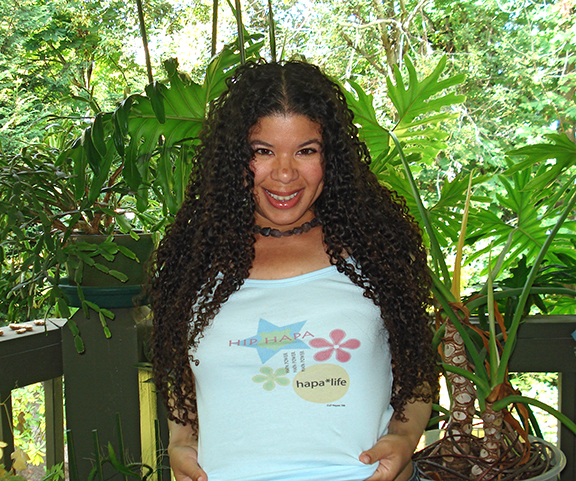
Hey, Hip Hapa Homeez, for whatever reason, Facebook can’t seem to leave well enough alone. So, our Hip Hapa Homeez Group is either going to get updated or archived. Remember, this is where you can post and read info about multiethnic news. As a new Group, we’ll have to re-add everyone to its membership. If we’re archived, I believe that won’t be possible. So, please become a member when the updated version becomes available. Also, we’ve created a Facebook Fan page for Hapa*Teez t-shirts since the Watermelon Sushi film website is being redesigned. If you’ve made a Hapa*Teez purchase, please drop us a line so we can list your name correctly for rear crawl credits and mention you on the new website! Check out Hapa*Teez on Café Press so you can look as lovely as Curly Like Me author Teri LaFlesh does in her t-shirt below. You can also “like” our Watermelon Sushi Fan page, and follow us on Twitter.


Until next time, I will always be…

Your Hip Hapa,
Yayoi