
My dear literature lovin’ Hip Hapa Homeez,
Two of our fellow Homeez have books being released this year. How exciting! Stay tuned for upcoming reviews and interviews with Teri LaFlesh (Curly Like Me) and Heidi Durrow (The Little Girl Who Fell from the Sky). It’s incredible how much literature is in circulation right now that chronicles our blendie and mixie lives. Congratulations to all of you amazing authors who keep us, and others, informed about our world.
Speaking of authors and bloggers, this week’s Hip Hapa Homee does her fair share of both. Emily Moberg Robinson attended Wellesley College where she majored in history and minored in music (“classic Asian American Suzuki violinist”, she says, adding that “95% of my Asian American friends growing up were violinists”). Emily then went to UC Santa Cruz for grad school and earned a PhD in early American religious history (Presbyterian political theology in Scotland and America), and an MA in Asian American history (Japanese American internees during WWII). After graduating in 2004, Emily’s been adjuncting occasionally, and is a full-time mom to, she says, “two very energetic boys, neither of whom are sleeping through the night with any regularity.”
Here is Emily’s link:
www.xanga.com/emilymr
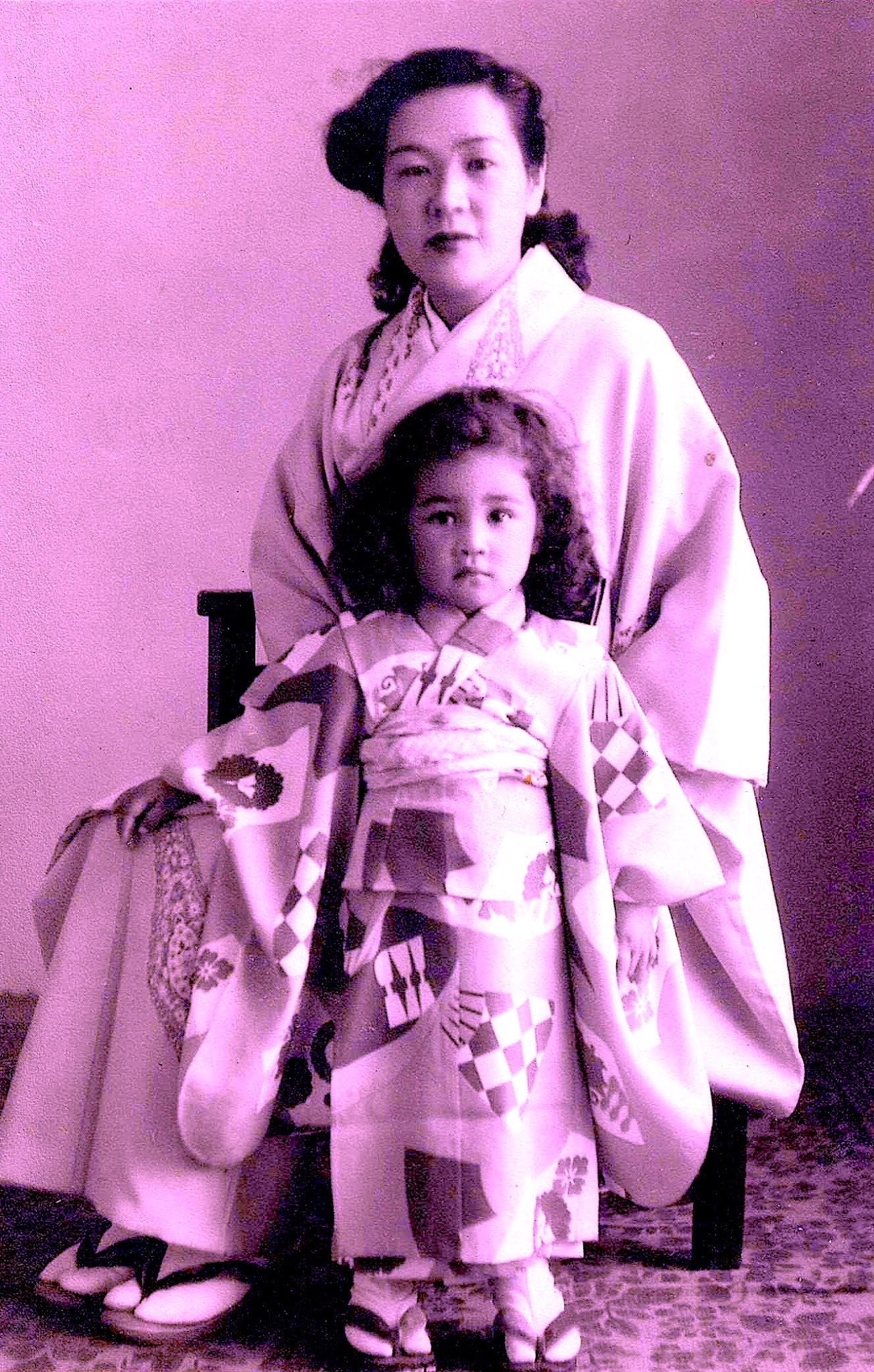
The photo above is of her (on right) next to her mother, her grandmother (seated) and sisters. Below, Emily (in kimono) poses with her sisters and cousin.

Q: What's a nice Japanese Caucasian girl like you doing blogging about your multi-culti family?
A: I started a mommy blog when my oldest son, Micah, (now 5) was a baby. Back then, I didn't have enough energy to think about much besides surviving his horrible colic and even more horrible sleeping habits. However, the first time I brought Micah to Hawai’i to meet my mom's side of the family, I plunked him down on my grandma's lap and she exclaimed, "He's ALL HAOLE!!!" It was a very funny moment (which of course I had to blog about), but it also further personalized my interest in race and ethnic identity. And the older Micah gets, the crazier his questions get. He recently asked me if he was “a person of color”, which threw me for a loop given his bright red hair and practically translucent white skin.
Q: How did your folks meet?
A: My mom is Japanese American; my grandmother emigrated from Okinawa when she was young, and my grandfather was a Nisei from Kauai. Mom grew up on Kauai, went to the mainland for college, and met my father in grad school at Syracuse University. Dad's side of the family is 100% Swedish American.
Q: So, how did you identify growing up?
A: I grew up in upstate New York. We lived in the inner city, in a mixed white-black neighborhood. My siblings and I went to a small Christian school, almost entirely white; and then transferred out of district to a suburban high school, again almost entirely white except for the few racial minorities from the city who were part of our desegregation program. We really grew up as an all-American family. We ate American food (although we had a rice cooker! and once or twice a year, the magic box from Hawai-i would appear, stuffed with arare, furikake, li hing mui, ramen, and Japanese curry), and our Japanese heritage was rarely discussed. We did take trips to Kauai to see Grandma, and if it was the right season we'd go to Bon dances at the Lihue Buddhist temple. But overall, I don't think I really felt like I was Japanese American until I got to college, and then even more in grad school when I started studying Asian American history.
Q: How did you meet your Caucasian husband, and was race a factor in your relationship?
A: We met in grad school, following in my parents' footsteps. (Wink!) Race has never been a factor between us. In fact, he went to Japan several times before I did, and he speaks way more Japanese than I do.
Q: How do you envision your sons’ futures as multiracial children in America?
A: Micah is 5, and Shiloh is 2 (we called him "Doosey" when he was in utero, poor child). I talk to both of them about their Japanese heritage, about Japanese American history. I always put up a picture of Micah when I'm lecturing on Asian American identity politics and ask my students if he "counts" as Asian American. I personally believe that perceptions of ethnicity are changing so quickly these days--both from within and from without ethnic communities--and individuals can and should decide for themselves how they want to define themselves. I'll be very happy if my boys decide to identify as Japanese Americans, and learn about what that's meant in the past.
Q: What’s the best part of your job?
A: I teach Asian American history at UC Santa Cruz. I'm an adjunct, and I teach one class a year. I love it! I have some great students who are passionate about the subject, and they always bring up things that I hadn't thought of myself.
Q: Tell us about the book you’re editing.
A: I'm working on an anthology of primary sources written by Asian Americans. My co-editor and I are collecting documents spanning Asian American history--from the mid-1800’s to today, editing them down to two pages, and writing short introductions to each of them. I'm really excited about the project--we're getting some great pieces, addressing contemporary issues as well as the classic historic ones. I've “met” some fascinating people who have been so helpful and gracious about letting us use their writing--that's been the most enjoyable part of the process for me, so far. ABC-CLIO is publishing it, and it should be out next year.
*********
Emily-san, arrigato gozaimasu and mahalo nui loa. You’re definitely about keeping culture alive.
Before Your Hip Hapa signs off, she’d like to thank AllPeople Gifts for sending the following links about celebrating American Heritage History months. As you know, February is Black History Month.
http://groups.yahoo.com/group/Generation-Mixed/message/4054
http://groups.yahoo.com/group/MGM-Mixed/message/957
http://groups.yahoo.com/group/FGM-Mixed/message/347
And word up to Janet Murray who sent us this link below to her piece titled “50 Sushi Tips for Beginners”.
http://www.mritechnicianschools.org/50-sushi-tips-for-beginners/
As always, here’s a word from our sponsors: Join the Hip Hapa Homeez group page on Facebook to be in the mix (ha ha) with news about multiracial communities. Sign up for the Facebook Watermelon Sushi fan page for film updates. Follow Watermelon Sushi on Twitter where we periodically post passages from the film script. And, finally, buy a Hapa*Teez t-shirt to support the film. You’ll earn a rear crawl credit if you do.
Until we meet again, here’s to HAPA reading from…
Your Hip Hapa,
Yayoi


 Finally, we are at the point in independent filmmaking where movies can be made without having to raise huge budgets through outside investors. So, watch for us in the next few months as we launch some innovative and creative ways to finance Watermelon Sushi. There will be non-donor based investment opportunities for everyone!


