This week’s featured Hip Hapa Homee is a powerful representative of the future in so many ways. Of both black and white descent, Carla Saulter is also Seattle’s famous Bus Chick--blogging about her experiences traveling via public transportation. If you swear you’re environmentally conscious, yet still drive a gas-guzzling car, check out what Carla has to say about that, below. Not only does she get to all the places she needs to get by bus, but she also manages to do it while looking good and towing two babies, too!
Check out Carla’s blog here: http://blog.seattlepi.com/buschick
In the first photo below, Carla can be seen in an ad on the side of a Metro bus. That picture was taken by folks at Seattle Transit Blog. Here’s the link to the original post:
Beneath that, Carla and her husband, Adam, pose on their wedding day in front of a vintage Metro bus they rented to transport guests to the reception.
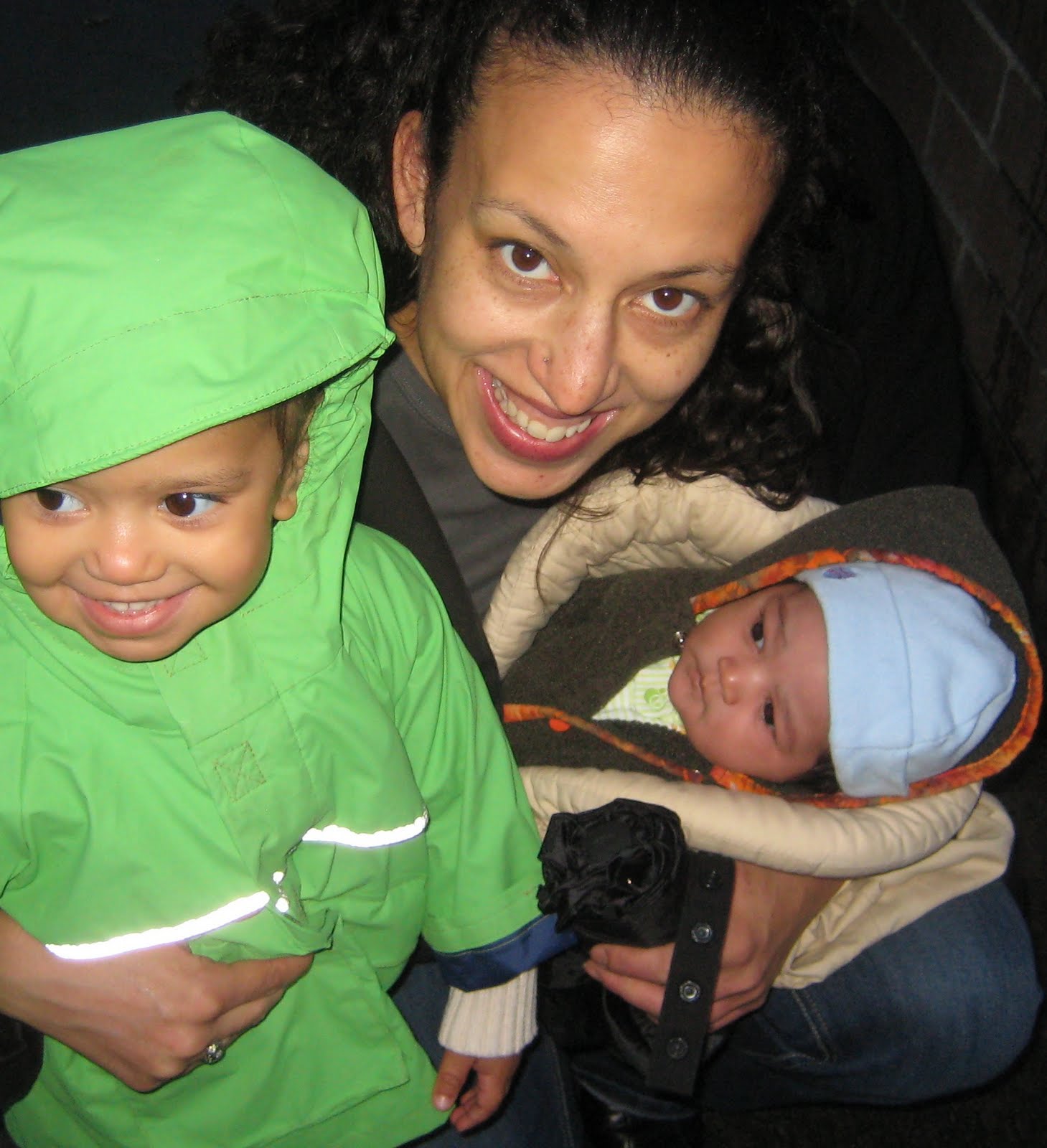
The picture of Carla with both children was taken shortly after her son, Quincy, was born while they headed to the International District to celebrate Lunar New Year.
Finally, the one of her, Adam and their daughter was taken while they were in transit.
Q: What's a nice multiethnic girl like you doing blogging about riding the bus?
A: Despite all of the stigmas that surround public transportation, buses are a writer’s dream. You have a vehicle filled with dozens of people—of all different ages, ethnicities, and life circumstances, with perhaps nothing more in common than the shared ride. It’s endless fodder for stories.
Of course, I don’t just write bus stories. I've found that I can use the bus as a jumping off point to talk about just about any subject, including my biracial identity. All it takes is a particular passenger, or incident.

Q: Tell us about your other writing.
A: I’ve written a novel—with a biracial protagonist, of course—which I’m probably not going to try to publish. I’m also working on a nonfiction book called Rules of the Ride: The Transit Rider’s Bible. It’s a fun handbook for and about transit geeks in the tradition of the BAP Handbook/Hipster Handbook. My agent is currently working to find a publisher for it.
Q: Who are your parents, and how were you raised?
A: I’m a pretty standard Seattle mixed chick. My father is black (with some fairly significant Cherokee heritage), and my mother is white (of Irish, English, and Scottish descent). They married in 1966, while they were still students at the University of Oregon. I am the second of their four children.
My parents did not agree on how we should be raised to identify. Though my father never discouraged us from identifying as bi-/multi-racial, he believed that we would be viewed as black in the eyes of most people and, therefore, should be raised to identify that way. My mother felt that us being labeled black was simplistic and negated her contribution to our existence.
Growing up in Seattle in the 70’s and 80’s, I was exposed to lots of other biracial kids. My best friend (whom I’ve known since seventh grade) is biracial, and so were many of the children I played with as a young girl. Because of this, I never felt as isolated as other biracial people who come from other parts of the country or who were born before it became so common.

Q: Your husband is also mixed. Does that enhance your relationship?
A: In some ways, yes. I think we understand each other on a pretty fundamental level because we had similar upbringings. Both of us have a white mother and black father and were raised in middle-class homes and exposed to both sides of our families. (Did I mention that we’re also both left-handed, car-free transit geeks?)
That said, my husband, who was raised in Detroit, doesn’t identify as biracial or talk about it much. He doesn’t see a distinction between himself and other black Americans, most of whom also have at least some white ancestry.
For me, it’s not about making distinctions; it’s about being honest about who you are. I am very proud to be black (and often feel insulted when others don’t recognize me as such), but that’s not all I am. So, when I want to vent about (or celebrate) being biracial, I call my best friend or one of my many other biracial girlfriends.
Q: How has motherhood affected your view of multiethnic identity? How will your children be raised?
A: When my daughter was born, it felt redemptive in many ways. I had lost my mother earlier that year to cancer and was grateful to have another chance at a mother-daughter bond. Also, having grown up in a family where I didn’t “match” either of my parents, it was wonderful to have a child who had hair and skin just like mine. I still grin from ear to ear whenever someone says that she looks like me.
I have thought a lot about this issue—mostly about how I will teach them to deal with the inevitable “What are you?” interrogations—but haven’t really thought much about how I will raise my kids to identify. They will be free to identify themselves in whatever way feels most appropriate and comfortable for them.
Q: Why are you so passionate about public transportation?
A: I originally decided to ride the bus as my primary form of transportation out of concern for the environment (driving a car is probably the single worst environmental choice a person can make), but I’ve found it has almost innumerable benefits. I save tons of money; I can use my travel time to read, nap, or work; I get exercise every day without setting foot in a gym; and I have contact with my community that would never be possible in the isolated bubble of a car.
I have also come to realize that every value I have—some of these include: equality, frugality, environmental stewardship, compassion— can be reflected in my choice to use public transportation. I wrote an essay about it for This I Believe, which has an audio version I recorded at KUOW radio.
And the truth is, I really enjoy the ride. I love sitting next to my neighbors, being on the ground in my city. I love watching and listening—and learning about my fellow human beings.
People who drive everywhere don’t know what they’re missing.

Q: What does the future of transportation look like to you--flying cars as in The Jetsons?
A: I think the future of transportation is inextricably linked to the future of the built environment. You can have the most efficiently run, well-funded agency and the newest, best vehicle technology, but you won’t have good transit if you don’t have a dense, walkable, well-planned city that’s built to accommodate it.
So, I see the future of transportation as a fundamental change in how we build cities. Hopefully, by the time my children are grown, living without a car will no longer be seen as an alternative lifestyle.
The Bus Chick has spoken! Thank you, Carla for your futuristic insights.
Okay, Hip Hapa Homeez, here’s the usual spiel. News about blendies and mixies is still being posted on the Hip Hapa Homeez Group page on Facebook. Please join it and add your comments to some of the hundreds of links there. Everything begins with communication, and if we want to see a colorless future, we need to discuss with each other ways to work towards that goal. Our Watermelon Sushi Fan page supports our Watermelon Sushi film, so please sign up to “like” it on Facebook, as well. And, watermelonsushi is on Twitter with excerpts from the Watermelon Sushi script as well as recipe ideas for The Official Watermelon Sushi Cookbook. Follow us, and we’ll follow you! Last but, by no means, not least, buy a Hapa*Teez t-shirt and earn a rear-crawl credit on the Watermelon Sushi film. Your purchase not only helps forward our multi-culti agenda, but you'll be recognized for it, too!
Here's another plug to my girl, Teri LaFlesh, whose book Curly Like Me was released this week. Help me help her by buying a copy.
The future is always in front of us, so watch where you walk. As always, I am
Your Hip Hapa,
Yayoi


