Showing posts with label Seattle. Show all posts

Wednesday, July 28, 2010

Dual Identified Designing Woman


Hola and neih hou, Hip Hapa Homeez! Once again, Your Hip Hapa is moved by your overwhelming support. Thank you for joining our Watermelon Sushi movement by “liking” our Watermelon Sushi Fan page on Facebook, following our sporadic tweets on Twitter, joining our Hip Hapa Homeez Group page on Facebook (where you can post news about multiethnic folks and transracial adoptees), and by supporting our Watermelon Sushi film by purchasing Hapa*teez t-shirts on Cafe Press. Without you, we don’t exist so please continue to journey on this fantastic voyage with us.

This week’s Hip Hapa Homee is clothing designer Chrissy Wai-Ching. Since one picture is worth 1,000 words, we’ve kept this interview short so you can check out Chrissy’s beautiful clothing line in the photos below. That’s her in the first three pictures wearing creations she designed, followed by shots of models dressed in her clothes.


Q: What's a nice multiethnic girl like you doing designing clothing?

A: I’ve been sewing since I was a little girl, since my Puerto Rican grandmother was an avid quilter. I started making clothing for myself in high school; then, went to University in Hong Kong and North Carolina, where I studied Textile Technology and Fashion Design. I started my line in Seattle in 2004.

Q: Who are your parents, and how did you grow up?

A: My father was Hong Kong Chinese, and my mother is Puerto Rican. I feel really lucky to have grown up with the two cultures. We took many trips to both places and celebrated both Puerto Rican and Chinese traditions and holidays.

Q: You've lived in many countries and still travel a lot. How do people in each locale deal with mixed-race people?

A: Puerto Rico is the most comfortable for me because everyone there is mixed-race. Hong Kong is an interesting place because, in some circles, I'm accepted as Chinese, and in others people don't believe that I am even mixed with Chinese!

I've noticed that the way I'm seen has changed a lot over the years. People are much more used to seeing mixed-race people all over the world now, whereas before it was more rare.

Q: What about you is uniquely Chinese or Puerto Rican?

A: I enjoy practicing Chinese art, like seal carving and calligraphy. Chinese tea and dim sum is my favorite! I speak some Chinese and also some Spanish. I often listen to Puerto Rican music, and feel the Puerto Rican lust for life in me.

Q: Besides being a fashion designer, you also create paintings and carvings. Tell us more about your other art interests.

A: I love to unwind with traditional Chinese art. It’s more about following a tradition and repetition than Western art, so I think there is a very meditative element to it.

Q: Please explain the Cantonese name Wai-Ching.

A: Wai-Ching is my Chinese name and it means Wisdom and Virtue.

Q: How can our readers buy your artwork and clothing?

A: My artwork and clothing can be purchased through my Seattle studio. I work with customers from all over the world. My website is www.wai-ching.com and the phone number is (206) 229-1111.

Mucho gracias and mhgoi saai, Chrissy!


Remember, Hip Hapa Homeez, you can get your own Hapa*Teez t-shirt like the one beautiful Cassie is wearing in this photo, below.


And, don’t forget that many of our Hip Hapa Homeez have products for sale. This week, we're featuring Thomas Brooks’ book, A Wealth of Family. You can read about him here.

See you in a two weeks with another blendie, hafu, hapa, mixie, multiethnic, FGM or MGM, cross-cultural person or transracial adoptee!

Your Hip Hapa,
Yayoi 


Wednesday, May 19, 2010

The Future In Black And White

Welcome back to Watermelon Sushi World, Hip Hapa Homeez! May you always live your lives unbound by any cultural, ethnic or racial barriers. Here, in our world, you are free to be—whether you are of blended ethnicities, transracially adopted, or simply enjoy mixing it up by crossing cultures.

This week’s featured Hip Hapa Homee is a powerful representative of the future in so many ways. Of both black and white descent, Carla Saulter is also Seattle’s famous Bus Chick--blogging about her experiences traveling via public transportation. If you swear you’re environmentally conscious, yet still drive a gas-guzzling car, check out what Carla has to say about that, below. Not only does she get to all the places she needs to get by bus, but she also manages to do it while looking good and towing two babies, too!

Check out Carla’s blog here: http://blog.seattlepi.com/buschick

In the first photo below, Carla can be seen in an ad on the side of a Metro bus. That picture was taken by folks at Seattle Transit Blog. Here’s the link to the original post:


Beneath that, Carla and her husband, Adam, pose on their wedding day in front of a vintage Metro bus they rented to transport guests to the reception.

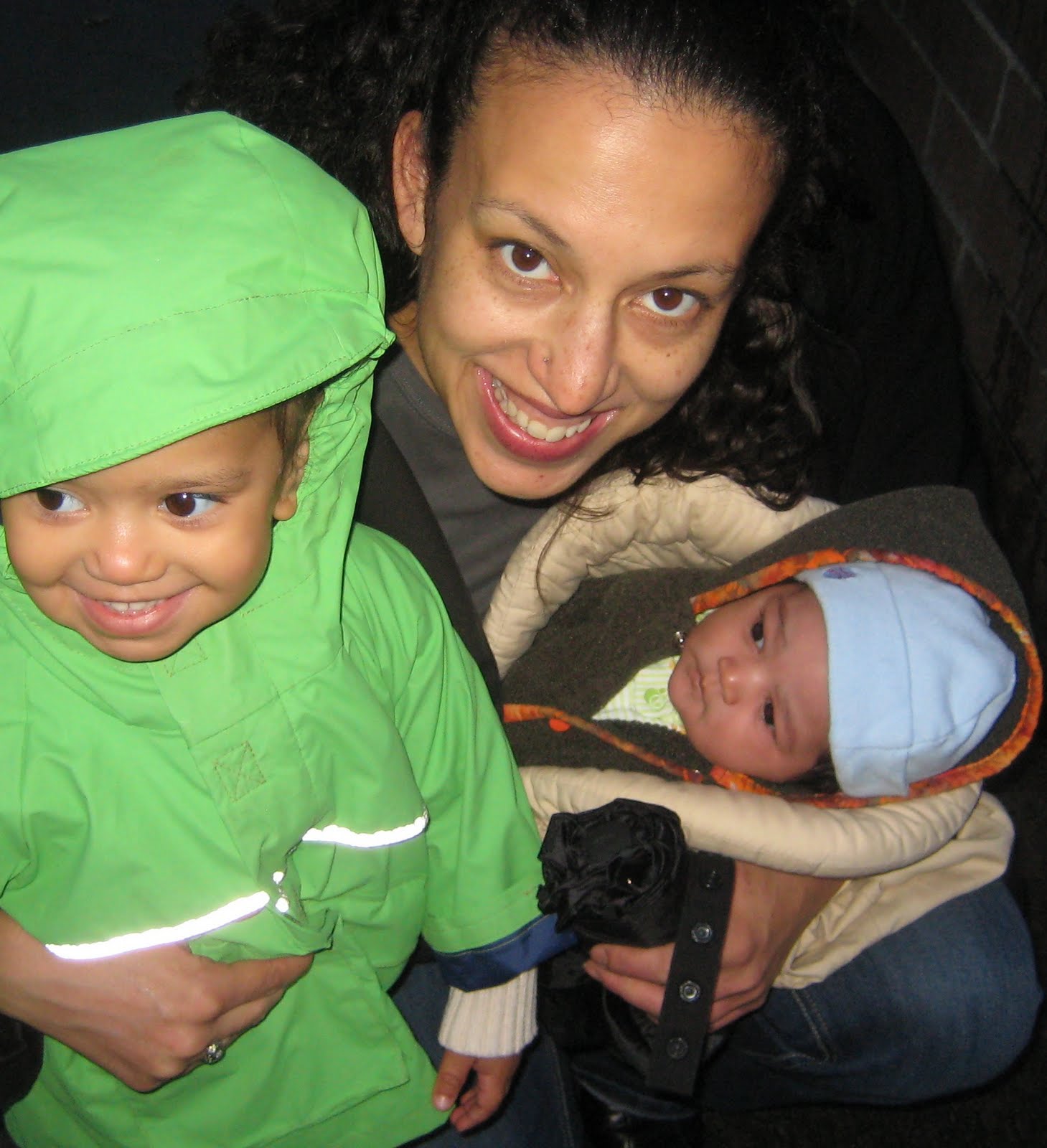
The picture of Carla with both children was taken shortly after her son, Quincy, was born while they headed to the International District to celebrate Lunar New Year.

Finally, the one of her, Adam and their daughter was taken while they were in transit.

Q: What's a nice multiethnic girl like you doing blogging about riding the bus?
A: Despite all of the stigmas that surround public transportation, buses are a writer’s dream. You have a vehicle filled with dozens of people—of all different ages, ethnicities, and life circumstances, with perhaps nothing more in common than the shared ride. It’s endless fodder for stories.
Of course, I don’t just write bus stories. I've found that I can use the bus as a jumping off point to talk about just about any subject, including my biracial identity. All it takes is a particular passenger, or incident.


Q: Tell us about your other writing.

A: I’ve written a novel—with a biracial protagonist, of course—which I’m probably not going to try to publish.  I’m also working on a nonfiction book called Rules of the Ride: The Transit Rider’s Bible. It’s a fun handbook for and about transit geeks in the tradition of the BAP Handbook/Hipster Handbook. My agent is currently working to find a publisher for it.
Q: Who are your parents, and how were you raised?

A: I’m a pretty standard Seattle mixed chick. My father is black (with some fairly significant Cherokee heritage), and my mother is white (of Irish, English, and Scottish descent). They married in 1966, while they were still students at the University of Oregon. I am the second of their four children.
My parents did not agree on how we should be raised to identify. Though my father never discouraged us from identifying as bi-/multi-racial, he believed that we would be viewed as black in the eyes of most people and, therefore, should be raised to identify that way. My mother felt that us being labeled black was simplistic and negated her contribution to our existence.
Growing up in Seattle in the 70’s and 80’s, I was exposed to lots of other biracial kids. My best friend (whom I’ve known since seventh grade) is biracial, and so were many of the children I played with as a young girl. Because of this, I never felt as isolated as other biracial people who come from other parts of the country or who were born before it became so common.

Q: Your husband is also mixed. Does that enhance your relationship?
A: In some ways, yes. I think we understand each other on a pretty fundamental level because we had similar upbringings. Both of us have a white mother and black father and were raised in middle-class homes and exposed to both sides of our families. (Did I mention that we’re also both left-handed, car-free transit geeks?)
That said, my husband, who was raised in Detroit, doesn’t identify as biracial or talk about it much. He doesn’t see a distinction between himself and other black Americans, most of whom also have at least some white ancestry.
For me, it’s not about making distinctions; it’s about being honest about who you are. I am very proud to be black (and often feel insulted when others don’t recognize me as such), but that’s not all I am. So, when I want to vent about (or celebrate) being biracial, I call my best friend or one of my many other biracial girlfriends.

Q: How has motherhood affected your view of multiethnic identity? How will your children be raised?
A: When my daughter was born, it felt redemptive in many ways. I had lost my mother earlier that year to cancer and was grateful to have another chance at a mother-daughter bond. Also, having grown up in a family where I didn’t “match” either of my parents, it was wonderful to have a child who had hair and skin just like mine. I still grin from ear to ear whenever someone says that she looks like me.
I have thought a lot about this issue—mostly about how I will teach them to deal with the inevitable “What are you?” interrogations—but haven’t really thought much about how I will raise my kids to identify. They will be free to identify themselves in whatever way feels most appropriate and comfortable for them.
Q: Why are you so passionate about public transportation?
A: I originally decided to ride the bus as my primary form of transportation out of concern for the environment (driving a car is probably the single worst environmental choice a person can make), but I’ve found it has almost innumerable benefits. I save tons of money; I can use my travel time to read, nap, or work; I get exercise every day without setting foot in a gym; and I have contact with my community that would never be possible in the isolated bubble of a car.
I have also come to realize that every value I have—some of these include: equality, frugality, environmental stewardship, compassion— can be reflected in my choice to use public transportation. I wrote an essay about it for This I Believe, which has an audio version I recorded at KUOW radio.
And the truth is, I really enjoy the ride. I love sitting next to my neighbors, being on the ground in my city. I love watching and listening—and learning about my fellow human beings.
People who drive everywhere don’t know what they’re missing.

Q: What does the future of transportation look like to you--flying cars as in The Jetsons?
A: I think the future of transportation is inextricably linked to the future of the built environment. You can have the most efficiently run, well-funded agency and the newest, best vehicle technology, but you won’t have good transit if you don’t have a dense, walkable, well-planned city that’s built to accommodate it.
So, I see the future of transportation as a fundamental change in how we build cities. Hopefully, by the time my children are grown, living without a car will no longer be seen as an alternative lifestyle.

The Bus Chick has spoken! Thank you, Carla for your futuristic insights.

Okay, Hip Hapa Homeez, here’s the usual spiel. News about blendies and mixies is still being posted on the Hip Hapa Homeez Group page on Facebook. Please join it and add your comments to some of the hundreds of links there. Everything begins with communication, and if we want to see a colorless future, we need to discuss with each other ways to work towards that goal. Our Watermelon Sushi Fan page supports our Watermelon Sushi film, so please sign up to “like” it on Facebook, as well. And, watermelonsushi is on Twitter with excerpts from the Watermelon Sushi script as well as recipe ideas for The Official Watermelon Sushi Cookbook. Follow us, and we’ll follow you! Last but, by no means, not least, buy a Hapa*Teez t-shirt and earn a rear-crawl credit on the Watermelon Sushi film. Your purchase not only helps forward our multi-culti agenda, but you'll be recognized for it, too!

Here's another plug to my girl, Teri LaFlesh, whose book Curly Like Me was released this week. Help me help her by buying a copy.


The future is always in front of us, so watch where you walk. As always, I am

Your Hip Hapa,
Yayoi

Wednesday, January 21, 2009

Obama Triggers Flashback To Germany

Yesterday, on That Day, I was scheduled to speak about biracial issues at a local high school. But when the kids tramped in, all they wanted to do was watch the streaming of the inauguration. As their teacher frantically fiddled with a computer, I tried to get the students'
attention. But, they were having none of it. Instead, I heard incessant complaining about why the streaming wasn't already happening. "I better not miss my president," one aggressive young lady warned us. After ten minutes of clicking keys, the teacher gave up and herded the kids into the cafeteria to watch the big screen TV with other students. Meanwhile, she and I headed to the library.

During the ceremony, I went over in my mind all the interesting paths that I've seemingly crossed with Obama. There's the fact that his mother attended Mercer Island High School near Seattle where I've resided on and off for a number of years. As a child, Obama lived in Honolulu. Well, I've lived in Honolulu, too--twice. My buddy, Lucy, currently lives in Kailua where the Obama's vacationed recently and where I visited Lucy's home last fall. Obama went to Occidental College in Eagle Rock. Several years ago, I spoke to a class there about biracial issues. I also met Anjulie, a transracial adoptee from Seattle, who has since become my good pal because she was in the class that I spoke to that day. And, I have a close friend who lives in Eagle Rock which is also the location of a newspaper that I used to write film reviews for. As for the inauguration, I'm acquainted with the poet who read the poem since she's a good friend of a friend. I seem to know a lot of folks in Chicago who knew Obama, too. And, the list goes on. Crossing paths these days is not so extraordinary given the world of social networking sites and instant communications. Still, it's something to ponder. Will I make the ultimate crossing with Mr. O with an invite to the White House? Now, that would be a trip!

While I watched Obama yesterday, I--of course--thought a lot about his biracial heritage. Later in the day, I appeared on the Mixed Chicks Chat special podcast to add my two cents about the subject. I had to admit that I was disappointed that Mr. O himself has said little about being mixed. Sure, he's referred to himself as a "mutt" and has revealed information about growing up with white grandparents, but it's not like he's in constant conversation about what it's like being biracial. Certainly, I don't expect him to push aside his presidential duties to focus on the multiracial agenda. Yet, I wish he'd do more.

For one thing, 2010 will be only the second time in the history of the U.S. Census that those of us who identify with more than one race group will be able to check more than one box. Think about it. For most of my life (which has been a l-o-o-o-ng one at this point), I've had to deny one of my parents. And, because the One Drop Rule for African Americans has been so prevalent, the person I had to pretend didn't exist inside of me was my Japanese mother. Even though she's influenced me more than any other living being on this planet, I, in effect, have had to announce to the world that she was no part of me. So, yes. I do believe that Mr. O could be a little louder about us biracial babies. Let's see if he does so once we get past all the economic and international problems we currently face.

Thinking about Obama, I also realized that most of the time when monoracial people use the term "biracial", they mean people who are half white and half black. That took me back to the time when my family lived in Germany where my father was stationed for three years. After moving back to the states, we ended up in an all-white neighborhood where no one would speak to us much less allow their children to interact with my sister and me. It was a lonely time for us, but she and I made good use of our solitude by nurturing our creativity.

But the really interesting thing to me now that I'm older and can look back is how white folks in Germany were nothing like the white neighbors in our Washington state home. For one thing, a lot of German kids then had black fathers. And the white Germans we knew were very friendly. Was it because they lost the war? The white American soldiers that worked with my father were friendly, too. Was it because of the Army?

As much as I prefer the idea of pure peace, I realize that having armed forces is a necessary thing. One of the benefits of being in the Army is that everyone is pretty much equal. Being forced together makes people learn tolerance. In civilian life, our white neighbors had the option of ignoring us, but in the military we all had to get along.

In these photos, clockwise: A soldier friend of my dad's visits us in Germany and sits my sister on his lap. Next, I believe this woman's name was PeeWee. She was German, and I don't remember whether or not she had a family. It seems everyone liked having my sister sit on their lap. In the next photo, we're having a picnic with a girl name Bridget, her German mother, Carmen (in the center, who is biracial), her German mother, my sister and me. The last photo is of me playing in the snow with two friends. I don't recall if they were German or American, but they never called me any derogatory names like our Washington neighbors did.

Until next time, I am...

Your Hip Hapa,
Yayoi


Monday, March 03, 2008

HAPA Birthday, Silvia B--War Bride Baby!

Silvia B (left in the photo) was my best friend in high school. We drew together because we were both considered weirdos among our so-called peers which only made us rebel more.

Although Silvia was very attractive with long silky black hair, green eyes and a husky voice, some of the athletes in our school (you know who you are Mr. Famous Football Player Who Married An Actress) would hiss and call her names whenever she walked down the hall. To this day, I still can't figure out why. Silvia didn't date anyone at our school so maybe they were just mad that she wouldn't give them a chance. After all, rejection is painful.

Besides, Silvia and I were both into older men anyway, especially musicians. Not that we went out with them either, but we did have our fantasies and they didn't include pimply-faced boys with crewcuts wearing lettermen jackets. I, in particular, would have never been able to date most of the boys in my school anyway, since I was "half Negro" and just about everyone else out of 1,500 students was white.

But Silvia was white, too--sort of. Like my mother, Silvia's mom was a war bride so maybe that took her down a notch in the eyes of the more "American" kids. Unlike my mother, Silvia's was a stay-at-home mom who raised a lot of kids--seven, if I remember correctly. A photo of Mrs. B sat in the living room, and whenever I was visiting I would stare at it in wonderment. Mrs. B was from Vienna and her picture showed a young woman with wavy auburn hair and a secret Mona Lisa smile similar to Silvia's. She spoke with a German/Austrian accent and smoked a lot of Tareyton 100's while drinking black instant coffee all day. Whenever she was in the mood, Mrs. B would tell us about her life during the war rattling off a litany of insults against Russian soldiers who, she claimed, would urinate in the sink and wash their hands in the toilet so uncouth were they. She hated Germans, too. Scar tissue from the war, I'm sure. Even though Mrs. B had lived in Austria, her parents were Czech and Yugoslavian and she considered herself a slav all the way. If I stayed for dinner, we might have eaten German potato salad made with oil and vinegar, or red cabbage cooked with wine.

I found it as fascinating listening to Mrs. B discuss the war in Europe as I did hearing my own mother talk about dodging bombs in Tokyo. That was a deep cultural connection that Silvia and I shared, but, at the time, I don't believe we even realized the impact of having war bride mothers. We just knew we didn't belong, and it made us do crazy things like when Silvia refused the advances of Jimmy Paige of Led Zeppelin backstage at a concert. Why should she have gone out with him anyway when her fantasy man was oh-so much more?

Silvia and I also hung out in Seattle's University District with our hippie friends, both of us with long, dangling hair, huge hoop earrings, and colorful satin skirts. Soon, the others began calling us The Gypsies.

Eventually, Silvia and I drove her '59 Chevy all the way to Pacific Grove California where we ended up living for six months among all the Timothy Leary drop-outs. It was an exhilarating time, but our middle-class upbringing didn't help us learn to survive hippiedom. So, we ended up back in the Northwest working at a television station, unbelievably, for the most controversial right-wing talk show host at the time.

Years passed, and eventually Silvia had a boyfriend, and then a son. I kept moving back to Cali and points beyond, but I would attempt to always stay in touch. After awhile, Silvia and I drifted so far apart that we couldn't reconnect. A few years ago, though, I found her and talked her into going to our high school reunion with me and my sister (who, for some reason, always goes to mine and not her own). As much as I hated my high school years, there's something intriguing about attending reunions and seeing all the people I hated as teenagers become adults.

Wherever you are Silvia B, know that you were a perfect friend at a time when I really needed someone like you. I salute you, and wish you a most HAPA birthday! (Although now that I've finished writing this, it's March 4 and no longer your day.) Hopefully, you don't mind me posting this snapshot of us taken at our 1998 reunion. Oh, yes. And, that's the gorgeous Maria Carter, the bellydancer, on the right. I didn't find out until that night that she is biracial, too--half Filipina and half Caucasian.

Namaste.

Your Hip Hapa,
Yayoi

P.S. Don't forget the t-shirts at http://www.cafepress.com/hapateez