Showing posts with label Teri LaFlesh. Show all posts

Wednesday, January 02, 2013

Another Year Here


Aloha, Hip Hapa Homeez.

As we say in Hawai’i, ‘Hau’oli Makahiki Hou’ for Happy Year New. Here’s wishing the best for you and yours in 2013.

Since this is Your Hip Hapa’s first blog post of the New Year, I'd like to make this month one of intermittent silence in honor of Hip Hapa Homeez that are no longer in our Watermelon Sushi World. During your busy days ahead, please take a few minutes to remember the following good folks:

Yuriko-san's first passport
First and foremost is my Mom, Yuriko-san. A Japanese war bride, she is the primary subject for the War Brides of Japan documentary. For those of you familiar with my media work spanning some 13 years now, you know that no one has had a more profound effect on my life than she did. Please join me in a sweet salute and a kind kiss skyward to the incredibly multi-talented Yuriko-san. 

Here’s one of my fave blogs about her:

Yuriko-san, left, with friend Emiko-san

Derrick-san in Tokyo


Also in November, we bid adieu to our astonishingly creative Director of Marketing and Publicity, Far East, Derrick Michael Holmes. A dancer, model, actor publicist and all-around great guy, Derrick will be missed not only for his extraordinary input as a promoter, but also for his kind-hearted generosity.


Here’s Derrick’s Facebook page: 


Ms. Muffin

On New Year’s Eve, Yuriko-san’s dog of 11 years joined her Mom on the other side of Watermelon Sushi World. Please say goodbye to our mixed-race mutt, Muffin:


Several years ago, I was dismayed to learn of the passing of a great filmmaker friend in Hawai’i. Here’s the blog I wrote about Sergio Goes, a cross-cultural Brazilian living in Honolulu, in 2008.


Since we’re taking this month to honor those who’ve left us, let’s also remember those still here who helped pioneer the mixed-race agenda.

Folks like author Teri LaFlesh:

author Teri LaFlesh


Arana and her Topaz Sisterhood:

Arana sitting in center

Nikki and son, Daniel
Euphoria Luv (now Asian Black Community):


Jen Chau of Swirlinc.org:

The Mixed Chicks and their Mixed Roots Film and Literary Festival:

If you know a mixed-race pioneer, or anyone forwarding our Hip Hapa Homeez agenda, drop us an email so we can interview them for our next month’s blog.

Meanwhile, watch our Hapa*Teez video and buy a t-shirt, like our Hapa*Teez fan page, check out our Watermelon Sushi film, like our Watermelon Sushi fan page, check out our War Brides of Japan videos, like our War Brides of Japan fan page, and join our Hip Hapa Homeez group page on Facebook to participate in discussions about being biracial, blended, interracially involved, mestizo, mixed race, multicultural and/or transracially adopted.

100 poems cards read for New Year's
Here’s to a HAPA New Year from…

Your Hip Hapa,

Yayoi

Wednesday, May 04, 2011

Hapa Japan Jams With Jero-san And Ms. Anime Eyes!


Hey, Hip Hapa Homeez!

Mad props to Duncan Ryuken Williams and his helpers for organizing the Hapa Japan Conference in Berkeley last month. No doubt, it was one of the best events Your Hip Hapa has ever attended. Shout-outs to all involved.

At the Berkeley campus on Friday and Saturday, the audience listened to various panels presenting on everything from Okinawan-Black mixies and the U.S. military to Japanese-Indigenous of Australia.

Jero-san gets an award while Duncan speaks and Your Hip Hapa looks on.
Photo courtesy of Edward Y. Sumoto.
Then, on Friday night, Duncan presented the New Vision Award to Japan enka singer and superstar Jero-san! Afterwards, we all had the chance to speak to, and take pix with, Jero-san. If you’re a long-time WSW blog reader, then you know how much Your Hip Hapa has admired this young man from Pennsylvania whose mother is Japanese and Black.

Later that evening, Jero-san performed a mini concert of five songs ending with a sing-along of Kyu Sakamoto’s Ue O Muite Arukou. What a bittersweet moment for those of us who remember “Kyu-chan” and his tragic death in 1985—20 some years after his Japanese language song made it to #1 in the U.S.!

At Saturday night's party; shortly after Jero-san handed the klutz some napkins.
Thanks for the snap, Fredrick Cloyd!
Following Saturday’s panel discussion, we headed to San Francisco’s Nihonmachi (J-town) for a party where Jero-san appeared with his manager. What a perfect gentleman! When Your Hip Hapa related how she had clumsily spilled sake on her hand, Jero-san immediately grabbed napkins from the table behind him and handed them to her.

Later that night, someone yelled, “All the Blackanese in the room stand with Jero-san for a picture!” What an incredible moment for all of us AfroAsians to gather around the man who crosses cultures with his incredible music. 

Blackanese in da houze with Jero-san (in red shoes) and Your Hip Hapa (on his left).
Photo courtesy of Jayson Carpenter  on behalf of Marcia Lise and The Hafu Project. 
And, of course, Your Hip Hapa talked to Jero-san about appearing in Watermelon Sushi. Wouldn’t you love to see him playing a role in the film? So would we!

So many special friendships were forged at the Hapa Japan Conference. In some cases, Your Hip Hapa finally met people for the first time that she’d been in touch with through cyberspace for decades—including painter and activist Lenore Chinn, after 12 years.

You’ll be reading about some of these fabulous folks here, over the next few months. This month, our guest is Athena Asklipiadis of Mixed Marrow. As she posed for a photo, I exclaimed, “You have anime eyes!” to which Athena replied, “Someone else told me that, too.” What do you think? Doesn’t she look as sweet and innocent as an anime character? Here's her link: http://www.mixedmarrow.org

Athena, sitting on right, with Mixed Marrow volunteers.
Q: Athena, how did your parents meet?

A: My father is Greek, Italian, Armenian and Egyptian born in Cairo. My mom is Japanese-American born in California. They met in Athens at a Japanese restaurant. At the time, my mom was a tourist and was curious about Japanese cuisine in Greece, and my father worked there.

Q: How did you grow up?

A: I grew up in a primarily African American and Latino community in South LA in the Crenshaw area. There, I was a very, very rare breed--the only person of my kind that I knew of in my whole neighborhood. I was called everything you could think of: "Chinese girl", "China" in Spanish, "white girl", and "flat faced" just to name a few. Being so different from people who lived near me and because the schools in my area were famous for shootings and gang activity, my parents sent me to school in a more diverse and safer neighborhood. But the "feeling different" thing didn't really end. I was still the minority because there weren't many mixed kids in the primarily white schools I attended. I suppose if I had siblings, it would have been a little easier having others like me around. But with time, race became less of an issue as my classmates grew up and got more mature; so, by high school it was not as much of a problem.

Q: What inspired you to create Mixed Marrow?

A: In 2007, my aunt Esther Matsuguma passed away with lymphoma and it really hit me hard. I was close to her and it was so difficult to see her suffering first-hand. After a year of coping with her loss, I was randomly approached at a Japanese festival in Los Angeles by a bone marrow donor recruiter. They asked if I was half Japanese and I said I was. Then, they told me about Krissy Kobata, a local girl my age who was in need of a bone marrow match. Her family was there signing up donors and it touched me that they were so diligent and hopeful that they would be able to save her. It made me think back to my aunt and her struggle. I had to sign up for her and for Krissy, so I did. After some thought, I decided I wanted to get more involved and volunteer with the recruitment organization that signed me up, Asians for Miracle Marrow Matches (A3M). I thought that if I could have done anything to save my aunt, I would have, but a transplant was not an option she was given. So for about one year, I volunteered with A3M. I did drives to recruit new donors, but in the process I realized our community--the mixed community--did not have this cause on its radar. I had been actively working with sites like Eurasian Nation, Addicted to Race and We Are Hapa, and I had never seen it mentioned on a large scale. I wanted to change that. So, with the help of A3M and the National Marrow Donor Program, Be The Match, I launched Mixed Marrow in 2009.

Q: What are some reasons that someone would need a bone marrow transplant?

A: Patients facing blood diseases like leukemia may be candidates for a transplant for either/or marrow or cord blood. Recent medical news has even shown positive results from stem cells helping with diseases like MS, heart disease, diabetes and even AIDS. These findings are happening every day and stem cell donation is still relatively new. That said, it’s not determined what the long-term effects are and if a complete cure can be achieved with the help of new stem cells.

Q: What are some misconceptions about donating marrow?

A: For one, there are two ways to donate; one similar to blood donation is done through the arm called PBSC donation and, the other is still done through the hipbone by needle. For the marrow donation through the hipbone--not spine like people think--a needle is used and you are not cut open surgically. You are also under anesthesia and do not feel the procedure. Also, marrow regenerates and you do not lose anything permanently.  

When it comes to cord blood donation, people hear "stem cells" and automatically think of embryonic stem cells and abortion. Cord blood stem cells come from the umbilical cord, which is usually disposed of 95% of the time. The cord blood donation process has no effect on mother or baby.

Q: One stat on your website indicates that a mixed-race person might have only 1 in 4 chances of being a match for a sibling. Does that mean mixed-race people are so different from each other even when they're related?

A: Any patient has a 1 in 4 chance of matching a sibling regardless of race. When it comes to mixed-race patients, the odds are lower because there are simply not enough donor matches in the registry. Part of the reason is because the majority of multiethnic people are under the age of 18 and, therefore, too young to donate marrow. The other reason is that there is lack of knowledge within our community and minority communities about the dire need for donors and what role ethnicity plays in matching.

Q: What are some activities your organization is involved with to bring attention to your cause?

A: Mixed Marrow hosts drives at ethnic festivals, book and art exhibits, museums, college campuses, and at various churches and businesses. Some past events include Kip Fulbeck's Exhibit openings, Loving Day's flagship event in New York, the Mixed Roots Film and Literary Festival, the Critical Mixed Race Studies Conference at DePaul, Harvard's So What Are You Anyways? Conference and Berkeley's Hapa Japan Conference. Besides onsite drives, Mixed Marrow also works to educate the public through awareness campaigns via film, radio, internet, and print media. Most recently, Mixed Marrow has teamed up with filmmaker Jeff Chiba Stearns to produce a feature-length documentary exploring the need for more diverse donors. The film is set to release in 2013.

Thank you, Ms. Anime Eyes!

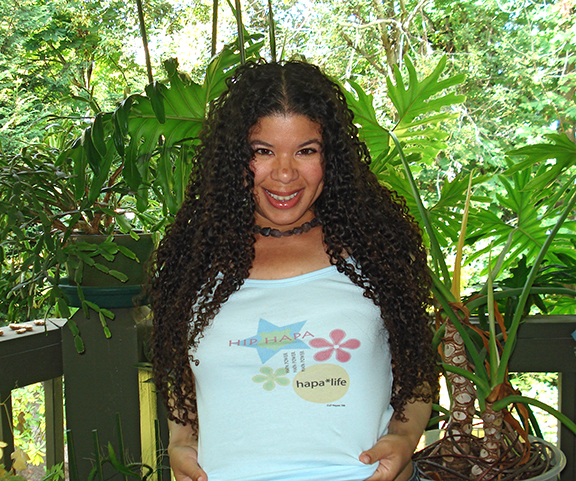
Hey, Hip Hapa Homeez, for whatever reason, Facebook can’t seem to leave well enough alone. So, our Hip Hapa Homeez Group is either going to get updated or archived. Remember, this is where you can post and read info about multiethnic news. As a new Group, we’ll have to re-add everyone to its membership. If we’re archived, I believe that won’t be possible. So, please become a member when the updated version becomes available. Also, we’ve created a Facebook Fan page for Hapa*Teez t-shirts since the Watermelon Sushi film website is being redesigned. If you’ve made a Hapa*Teez purchase, please drop us a line so we can list your name correctly for rear crawl credits and mention you on the new website! Check out Hapa*Teez on Café Press so you can look as lovely as Curly Like Me author Teri LaFlesh does in her t-shirt below. You can also “like” our Watermelon Sushi Fan page, and follow us on Twitter.


Until next time, I will always be…

Your Hip Hapa,
Yayoi

Wednesday, June 02, 2010

Hafus: Japanese Hapas


Yo, Hip Hapa Homeez! Big ups and mad love to all you blendies, mixies, and multi-culti mortals here in our Watermelon Sushi World.

Our featured Hip Hapa Homee this week is Megumi Nishikura, director and producer of Hafu, a film about the experiences of mixed-race people living in Japan. To learn more about Megumi’s documentary project, visit the link here: http://www.hafufilm.com

The flyer for the film appears below followed by photos taken at a fundraising party for Hafu. Megumi is in the red dress.


Q: What's a nice hafu girl like you doing making a film about multiethnic Japanese people?

A: Hafu feels like the film I was destined to make. I’ve been exploring my own dual identity for a number of years through personal films. However, when I realized how little mainstream media coverage there was of this subject in Japan, I felt called forth to share the experiences of people who identify as hafus with a greater audience. Hafu is the Japanese term for "half" and signifies that one is half-Japanese and half something else. At the moment, we are using this as the title of the film as it is the most recognizable term to call people who are mixed-Japanese, but this may change later.


Q: Who are your parents and how did you grow up?

A: My mother is Irish-American and my father is Japanese. My mother came to Japan to teach English in the mid-1970s and met my dad at a party. He's a bit on the stocky side, so she remembered him by thinking, "Ooh, here's a fat Japanese!"…and the rest was history. I was born a few years later in Tokyo.

I feel very blessed to have had the upbringing I did. My father's work as a journalist took us to the Philippines, China and to the U.S. I went to high school in Hawai’i and then to film school in New York. I was raised to appreciate other cultures and languages as well as have a good understanding of my own. As a result, I consider myself to be citizen of the world, more than a citizen of any one country.

Tokyo was our home base, and about 1/3 of my life has been in Japan. As a hafu child growing up here, I was stared at, teased, and called a "foreigner" or "half human." Somehow, I had the awareness that this was just childhood antics and laughed it off--never letting it penetrate too deeply. Luckily, through family friends and attending international schools, I was never far from the company of other hafus. When I left Japan for high school and university in the U.S., I noticed how people approached me differently than they had in Japan. People would ask out of curiosity, "What are you?" They seemed far more open-minded and sincerely interested in my diverse make-up.

Even today, I am treated as a foreigner on a daily basis here in Tokyo because of my external appearance. However, since coming back to Tokyo nearly four years ago, the more time I spend here, the more that I feel that this is my home and these Tokyoites are my people.


Q: How much do you know about Japanese culture?

A: I've lived in Japan for about 10 years. I speak the language proficiently enough to do a job here, but I still struggle when it comes to reading and writing. Japanese culture has always been a matter of fact for me, i.e., we eat seaweed-wrapped rice balls, have super efficient fast trains and toilets, and wear kimono on special occasions. I've never had more or less interest in it than my American side.

Q: What inspired you to make this film?

A: In 2006, when I returned to Japan to attend graduate school, I was confronted as an adult to reexamine what it means to be Japanese and hafu. With a "look" that is not even perceived as the "hafu-look" by Japanese, I am often complimented on the level of my Japanese language ability. When Japanese people meet me for the first time, it is often to their disbelief that someone with my name—a fully Japanese one—could look so foreign to them. They sometimes ask, "Is your husband Japanese?"

Last June, I came across a photo/research project called the Hafu Japanese Project (http://www.hafujapanese.org) started by Marcia Yumi Lise and Natalie Maya Willer. I got in touch with them, offered my skills as a filmmaker, and we began by interviewing people on the streets of Tokyo about their perceptions of hafus. From this collaboration, the seeds of this feature documentary film was born. I also met my filmmaking partner Lara Perez Takagi through their project.

My intention with this film is to contribute to a dialogue about the changing face in Japan. According to the 2008 findings of the Japanese Ministry of Health, Labor and Welfare, one in thirty babies born in Japan today are born to a couple where at least one of the parents is not Japanese. That's a lot of people who will grow up with bi-cultural identities in a country that once proudly proclaimed itself to be homogeneous.

I believe that the definition of what it means to be Japanese needs to change and change in a way that includes people like myself and the participants in this film. Most of all, I want to create something that will open up people's perceptions to what the hafu experience is like and to remind them of our common humanity. 


Q: Why does it seem like the Japanese refer to hafu as someone who is half European and not of other mixes.

A: Most likely the reason is because of how hafus are portrayed in the media. Hafus are often considered kawaii (cute) or kakkoi (cool) because what people see on television are models, singers, sports players and other performers. Most of these hafus are Eurasian or half-North American. There is very little coverage of other hafus and what their everyday lives are like in Japan. In this film, we are hoping to reflect the tremendous diversity within the hafu community.

Our first participant is David Yano (pictured above) who is Ghanaian and Japanese. David was raised in an orphanage here in Japan when his parents divorced due to cultural differences. Yet, despite this, when he traveled back to Ghana in his early twenties, he realized how blessed he was to have grown up in Japan. Now, he is using his talents as a musician/performer to raise funds to build schools in Ghana. He's set the goal of raising approximately $30,000 by September. 

Our other confirmed story is the Mexican-Japanese Oi family. Gaby and Testuya, the parents, met when they were studying in the U.S. After returning to Japan, they started a family and had Alex in 2000 and Sarah two years later. It is through their story that we hope to show the challenges and joys in raising a multicultural and multilingual family. Alex has experienced ijime (teasing) at school, and now his parents are making the difficult decision whether or not to send their children to the public Japanese school or the more expensive international school system.

We are also hoping to tell the story of an Asian-mixed hafu and, of course, the Eurasian hafu to give a more complete picture of the diversity of hafus within Japan.

Q: What's the status of the film?

A: We began production at the beginning of the year and, thus far, have completed initial interviews with David and the Oi family. We have started talking with an initial third participant for the film and, once we do our first interview with him, we will publicly reveal who he is and his unique story of growing up hafu in Japan.

As mentioned before, we are looking to film an Asian-mixed hafu. We consider Asian-mixed hafus to be the "invisible hafus" because from external appearances they may look no different than the average Japanese person, but because of their bi-cultural upbringing they themselves identify as hafu.

We also recognize that there is a greater diaspora of hafus who have little or no experience of Japan. We are hoping to find someone who is about to arrive in Japan to experience their Japanese side and follow them over the course of several months to see what their expectations are of Japan and whether their time here will live up to them.

If you know anyone who fits this description please get in touch with us at info@hafufilm.com

Also, as this is an independent film, we are fundraising in order to help us continue our production. This includes applying for grants and approaching sponsors, but we are also hoping to build a community of committed fans who will help us to see this project through to the end. If you are interested in contributing, you can find out how to do that on our website (http://www.hafufilm.com) or by attending our sneak preview event on June 12.


Q: Tell us about that event.

A: We will be showing a sneak preview of the film as a way to fund raise for the film. The reason we selected June 12 is because in the U.S. it is Loving Day--the day that interracial marriage was legalized in 1967. While Japan never had anti-miscegenation laws, I feel that any significant movement towards civil rights and liberties should be honored and celebrated. Also, as I am part American, this day resonates deeply with me and, last year, I worked with the Loving Day team to help them produce a video about their flagship celebration in New York City.

We thought that June 12 would be the perfect opportunity for us to celebrate the growing diversity within Japan. The celebration will be taking place in Aoyama, Tokyo and we will have performances from a hafu comedic duo, who will crack jokes about being hafu in Japan, and a Korean-Japanese belly dancer. And, we will be presenting our film idea and about 15 minutes of footage.

We had a small kick-off party at my apartment in mid-May (picture above). Not only did we have a great turn out, but the response to our first six-minute clip was tremendous! We're currently busy editing away our second story to show on June 12. For anyone in Tokyo, I hope you can come out and support this important film!

Domo arrigato gozaimashita, Megumi-san. Much good fortune on your film project. Your Hip Hapa is very familiar with what it takes to make a movie and would like to remind you Hip Hapa Homeez that we’re still selling Hapa*Teez t-shirts to support our feature dramadey Watermelon Sushi. You can also show us love by joining our Watermelon Sushi Fan page on Facebook and, while you’re there, sign up on our Hip Hapa Homeez Group page. That’s where we post mixed-race and transracial adoptee stories, while we update you on the film at the Watermelon Sushi Fan page.

Normally, we post requests like the following on the Hip Hapa Homeez Group page, but for Alana Young's unusual need--the more exposure, the better. She’s looking for a quote from a person of mixed heritage, preferably more than two races. The quote will be used for a short speech at a symposium to share with new incoming university students to empower them about who they are as a person and their cultural background.

You can send your suggestions to alanayoung2001@yahoo.com or friend Alana Young on Facebook.

Finally, filmmaker Tim Nagae who was profiled here on August 26 of last year has won a Hometown Video Competition prize for his documentary about legendary Detroit African American artist Charles McGee. Tim, who is Japanese, says the film Charles McGee – Nature has been broadcast on local PBS TV stations and film festivals, too. Check out the prize at: http://www.alliancecm.org/hometownwinners (go to item #38).

And, don't forget Teri LaFlesh's amazing book, Curly Like Me, which you can purchase here.

Until we meet again, I am

Your Hip Hapa
Yayoi


Wednesday, May 19, 2010

The Future In Black And White

Welcome back to Watermelon Sushi World, Hip Hapa Homeez! May you always live your lives unbound by any cultural, ethnic or racial barriers. Here, in our world, you are free to be—whether you are of blended ethnicities, transracially adopted, or simply enjoy mixing it up by crossing cultures.

This week’s featured Hip Hapa Homee is a powerful representative of the future in so many ways. Of both black and white descent, Carla Saulter is also Seattle’s famous Bus Chick--blogging about her experiences traveling via public transportation. If you swear you’re environmentally conscious, yet still drive a gas-guzzling car, check out what Carla has to say about that, below. Not only does she get to all the places she needs to get by bus, but she also manages to do it while looking good and towing two babies, too!

Check out Carla’s blog here: http://blog.seattlepi.com/buschick

In the first photo below, Carla can be seen in an ad on the side of a Metro bus. That picture was taken by folks at Seattle Transit Blog. Here’s the link to the original post:


Beneath that, Carla and her husband, Adam, pose on their wedding day in front of a vintage Metro bus they rented to transport guests to the reception.

The picture of Carla with both children was taken shortly after her son, Quincy, was born while they headed to the International District to celebrate Lunar New Year.

Finally, the one of her, Adam and their daughter was taken while they were in transit.

Q: What's a nice multiethnic girl like you doing blogging about riding the bus?
A: Despite all of the stigmas that surround public transportation, buses are a writer’s dream. You have a vehicle filled with dozens of people—of all different ages, ethnicities, and life circumstances, with perhaps nothing more in common than the shared ride. It’s endless fodder for stories.
Of course, I don’t just write bus stories. I've found that I can use the bus as a jumping off point to talk about just about any subject, including my biracial identity. All it takes is a particular passenger, or incident.


Q: Tell us about your other writing.

A: I’ve written a novel—with a biracial protagonist, of course—which I’m probably not going to try to publish.  I’m also working on a nonfiction book called Rules of the Ride: The Transit Rider’s Bible. It’s a fun handbook for and about transit geeks in the tradition of the BAP Handbook/Hipster Handbook. My agent is currently working to find a publisher for it.
Q: Who are your parents, and how were you raised?

A: I’m a pretty standard Seattle mixed chick. My father is black (with some fairly significant Cherokee heritage), and my mother is white (of Irish, English, and Scottish descent). They married in 1966, while they were still students at the University of Oregon. I am the second of their four children.
My parents did not agree on how we should be raised to identify. Though my father never discouraged us from identifying as bi-/multi-racial, he believed that we would be viewed as black in the eyes of most people and, therefore, should be raised to identify that way. My mother felt that us being labeled black was simplistic and negated her contribution to our existence.
Growing up in Seattle in the 70’s and 80’s, I was exposed to lots of other biracial kids. My best friend (whom I’ve known since seventh grade) is biracial, and so were many of the children I played with as a young girl. Because of this, I never felt as isolated as other biracial people who come from other parts of the country or who were born before it became so common.

Q: Your husband is also mixed. Does that enhance your relationship?
A: In some ways, yes. I think we understand each other on a pretty fundamental level because we had similar upbringings. Both of us have a white mother and black father and were raised in middle-class homes and exposed to both sides of our families. (Did I mention that we’re also both left-handed, car-free transit geeks?)
That said, my husband, who was raised in Detroit, doesn’t identify as biracial or talk about it much. He doesn’t see a distinction between himself and other black Americans, most of whom also have at least some white ancestry.
For me, it’s not about making distinctions; it’s about being honest about who you are. I am very proud to be black (and often feel insulted when others don’t recognize me as such), but that’s not all I am. So, when I want to vent about (or celebrate) being biracial, I call my best friend or one of my many other biracial girlfriends.

Q: How has motherhood affected your view of multiethnic identity? How will your children be raised?
A: When my daughter was born, it felt redemptive in many ways. I had lost my mother earlier that year to cancer and was grateful to have another chance at a mother-daughter bond. Also, having grown up in a family where I didn’t “match” either of my parents, it was wonderful to have a child who had hair and skin just like mine. I still grin from ear to ear whenever someone says that she looks like me.
I have thought a lot about this issue—mostly about how I will teach them to deal with the inevitable “What are you?” interrogations—but haven’t really thought much about how I will raise my kids to identify. They will be free to identify themselves in whatever way feels most appropriate and comfortable for them.
Q: Why are you so passionate about public transportation?
A: I originally decided to ride the bus as my primary form of transportation out of concern for the environment (driving a car is probably the single worst environmental choice a person can make), but I’ve found it has almost innumerable benefits. I save tons of money; I can use my travel time to read, nap, or work; I get exercise every day without setting foot in a gym; and I have contact with my community that would never be possible in the isolated bubble of a car.
I have also come to realize that every value I have—some of these include: equality, frugality, environmental stewardship, compassion— can be reflected in my choice to use public transportation. I wrote an essay about it for This I Believe, which has an audio version I recorded at KUOW radio.
And the truth is, I really enjoy the ride. I love sitting next to my neighbors, being on the ground in my city. I love watching and listening—and learning about my fellow human beings.
People who drive everywhere don’t know what they’re missing.

Q: What does the future of transportation look like to you--flying cars as in The Jetsons?
A: I think the future of transportation is inextricably linked to the future of the built environment. You can have the most efficiently run, well-funded agency and the newest, best vehicle technology, but you won’t have good transit if you don’t have a dense, walkable, well-planned city that’s built to accommodate it.
So, I see the future of transportation as a fundamental change in how we build cities. Hopefully, by the time my children are grown, living without a car will no longer be seen as an alternative lifestyle.

The Bus Chick has spoken! Thank you, Carla for your futuristic insights.

Okay, Hip Hapa Homeez, here’s the usual spiel. News about blendies and mixies is still being posted on the Hip Hapa Homeez Group page on Facebook. Please join it and add your comments to some of the hundreds of links there. Everything begins with communication, and if we want to see a colorless future, we need to discuss with each other ways to work towards that goal. Our Watermelon Sushi Fan page supports our Watermelon Sushi film, so please sign up to “like” it on Facebook, as well. And, watermelonsushi is on Twitter with excerpts from the Watermelon Sushi script as well as recipe ideas for The Official Watermelon Sushi Cookbook. Follow us, and we’ll follow you! Last but, by no means, not least, buy a Hapa*Teez t-shirt and earn a rear-crawl credit on the Watermelon Sushi film. Your purchase not only helps forward our multi-culti agenda, but you'll be recognized for it, too!

Here's another plug to my girl, Teri LaFlesh, whose book Curly Like Me was released this week. Help me help her by buying a copy.


The future is always in front of us, so watch where you walk. As always, I am

Your Hip Hapa,
Yayoi

Wednesday, May 05, 2010

"Curly Like Me" In Da Houze! (And In Bookstores, Too!)

Hey, Hip Hapa Homeez! Welcome back to our world where we embrace your multiethnic selves, transracially adopted upbringings, and cross-cultural lifestyles. In fact, anything that represents your unique experience as a multi-culti or blendie-mixie is what we hold most dear.

Speaking of, one of my dearest friends and the first Facebook person I ever met in the flesh (pun intended) is also this week’s featured Hip Hapa Homee, Teri LaFlesh. Known by many women for her fabulous hair and valuable advice on how to make theirs look like hers, Teri is finally having her book (published by Wiley) on the market this week. 

Check out her links below then move on down to the Q&A. Be inspired by Teri’s “before” and “after” photos, too, and click the Amazon link to buy her book.


Q: What's a nice multiethnic girl like you doing writing a book about hair?

A: Actually, it was in large part due to my being mixed that ultimately inspired me to write this book about hair. I half grew up with my mom, who is black, and experienced how very curly hair is dealt with in many black communities--especially at the time I was growing up. Mostly, the choices were relaxers, hot combs, or the brand new Jheri curl. All the women on my mom’s side of the family relaxed their hair. So my hair was relaxed before I even knew it was curly. Since my hair is very fine, it fell apart under the lye-like chemicals, and became as stiff as fondant.

In my teenage years, I lived with my dad, who is white. We lived in a white neighborhood, his wife was white, and all my family on that side was white. Suddenly, I was left alone to care for my hair. It was a shock to me that it grew out curly. I had no idea what to do with it, and I tried to treat it like the hair of everyone around me (which was a disaster). So there I was, the only person of color in my entire vicinity, and I had this super-curly hair I had no idea what to do with. And, that curly hair that was like no one else’s hair began to symbolize how I felt about my place in the world at that time. I felt like an outsider, but an outsider who was let into the inside. I belonged, and yet I looked totally different from everyone I saw, so I felt I didn’t really belong. And, my crazy hair that puzzled and alarmed people around me seemed to be proof that I was different.

So, when I finally (finally!) figured out what my hair wanted (which was the hair equivalent of being loved and accepted for what it was, even if that was a bit different from everyone else), I wanted to make sure no other mixie girl with crazy curly hair like mine ever had to feel alone, or like there was something wrong with her because her hair seemed so different from either parent’s.

Q: How did you grow up?

A: I grew up in two environments that were polar opposites. I spent my early years with my mom, who is black. She was a public school art teacher (which meant we never had much money, and she was very creative), and lived in a black neighborhood. She was religious and lived in the south. I was surrounded by my outspoken family and lots of pets. Our place was always messy, and we ate junky food whenever we wanted. I went to a public school. We had few rules. I was bossy and the center of attention, and I mostly ran wild.

I spent my teenage years with my dad, who is white (as was his wife). He and his wife were computer programmers, so we had money. They were atheists. We lived in the northwest in an all-white town where I went to private schools. Our house was quiet and ordered and spotless, with no pets. We ate healthy food, but only at certain, previously arranged times. My life was run by rules. I was awkward and quiet, and very shy.

So I grew up not only between two races, I had two totally different childhoods, and lived as two different people with totally different personalities to fit those environments. But each environment taught me totally different and necessary skills I needed in life.

Q: Explain why you call yourself a "Former Mushroom Head Kid". 

A: In the transition from living with my mom to going to live with my dad, a hairdresser gave me a Jheri curl over the relaxer my mom already gave me. The hairdresser had told me and my mom that as the curl grew out, I would have little ringlets on the ends of my straight hair. This sounded really pretty. Then, I went to spend that summer with my dad. When my dad saw the greasy Jheri curl activator, he forbid me using it. So, I dry brushed my already damaged hair every day into a crunchy cloud, and patted it into a round shape, and waited for that straight hair to grow out with the ringlets on the ends. It never came because (to my surprise) my hair wasn’t straight. In fact, it was very curly. Instead, my now triply damaged hair got bigger and bigger until it turned into a mushroom shape (see photo). The sad thing is I thought that stiff, broken hair-cloud was what my natural hair was like, and it was a specter that haunted me for many years whenever I thought about possibly going natural.


Q: There's so much good, scientific information in your book. How long did it take you to write it?

A: Aw, thank you for saying that! I did a ton of research for it. I’d say the book took about two years to do. The first year, I wrote it in snatches of free time, such as when I was riding the train to and from work, and would type what I’d written when I got home. The second year I spent taking the pictures for the book, and researching and drawing the illustrations for it.

Actually, it took me about 30 years of trying to figure out what to do with my hair. I figured it out for selfish reasons: I wanted hair that wasn’t an ordeal, but was just hair and not a big deal. I had no intentions of writing a book. It was one day (after I’d figured out how to make my hair happy) that I realized I hardly thought about my hair any more, and it was down to my waist, and I was happy with it. It was then that I thought I might have found out some things others might really want to know, too (and may not want to have to struggle for 30 years to discover).

Q: Will there be a book tour?

A: At this time, there is a tiny tour planned, but I’ll probably mostly sign books in bookstores in my travels visiting relatives. I’ll be at the Mixed Roots Film and Literary Festival in June. Honestly, I’m pretty shy in real life, so I’m happy keeping things lower key. 

Q: What do you make of the current influx of published works by multiethnic people?

A: I think multiethnic people have had a very strong voice throughout time, however, they were often lending their voices to other fights, and their multiracial heritage was often downplayed, overlooked, or not acknowledged. Recently there has been an explosion of voices speaking as multiracial, and now refusing to be mashed into only one box. That’s very powerful and wonderful. I actually mark the turning point (for the media at large) as Tiger Woods, who helped put multiracial on the map. Often, when a race other-than-white is mixed with white, it seems to be the race of color that comes to dominate that person’s label to the world. Woods was one of the first celebrities I remember hearing about that wasn’t half white. Since he didn’t have a white parent (so he couldn’t just be lumped into the other-race-besides-white category), there wasn’t that neat default of placing him into the race of color as his automatic identity. Now people had to think about what he actually was for a moment: was he ‘Black’ or ‘Asian’ or ‘Something Else’? I think that not having an easy answer helped open many doors to the idea of being more than just one thing. Oooh. I hope that makes sense.

Q: What other writing projects do you have planned?

A: I’m working on a collection of short stories about my years running around as a wild child in the woods of Kentucky. I did some goofy things in those days, and was lucky enough to live in a home that let me get away with way more than I should have.

Congratulations, Teri! What an amazing author and humble Hip Hapa Homee, you are. btw, I love this quote from you: “When I made peace with my hair, I made peace with myself.”

Lately, Your Hip Hapa has been saving controversial clips (Sandra Bullock’s black baby, etc.) for the Hip Hapa Homeez Group page on Facebook. If you’d like to engage in a discussion, please join the group and leave your comments at any one of some 500 links posted there. Also, please sign up to “like” our Watermelon Sushi Fan page. Since Facebook has changed the rules, you no longer have to become a “fan”, but can just like us. You can also follow us on Twitter where we post dialogue from the Watermelon Sushi film script, and we promise to follow you back. Finally, show some love for the Watermelon Sushi film by checking out our Hapa*Teez t-shirts.

Until we meet again in our Watermelon Sushi World, I am

Your Hip Hapa,
Yayoi