Wednesday, May 19, 2010

The Future In Black And White

Welcome back to Watermelon Sushi World, Hip Hapa Homeez! May you always live your lives unbound by any cultural, ethnic or racial barriers. Here, in our world, you are free to be—whether you are of blended ethnicities, transracially adopted, or simply enjoy mixing it up by crossing cultures.

This week’s featured Hip Hapa Homee is a powerful representative of the future in so many ways. Of both black and white descent, Carla Saulter is also Seattle’s famous Bus Chick--blogging about her experiences traveling via public transportation. If you swear you’re environmentally conscious, yet still drive a gas-guzzling car, check out what Carla has to say about that, below. Not only does she get to all the places she needs to get by bus, but she also manages to do it while looking good and towing two babies, too!

Check out Carla’s blog here: http://blog.seattlepi.com/buschick

In the first photo below, Carla can be seen in an ad on the side of a Metro bus. That picture was taken by folks at Seattle Transit Blog. Here’s the link to the original post:


Beneath that, Carla and her husband, Adam, pose on their wedding day in front of a vintage Metro bus they rented to transport guests to the reception.

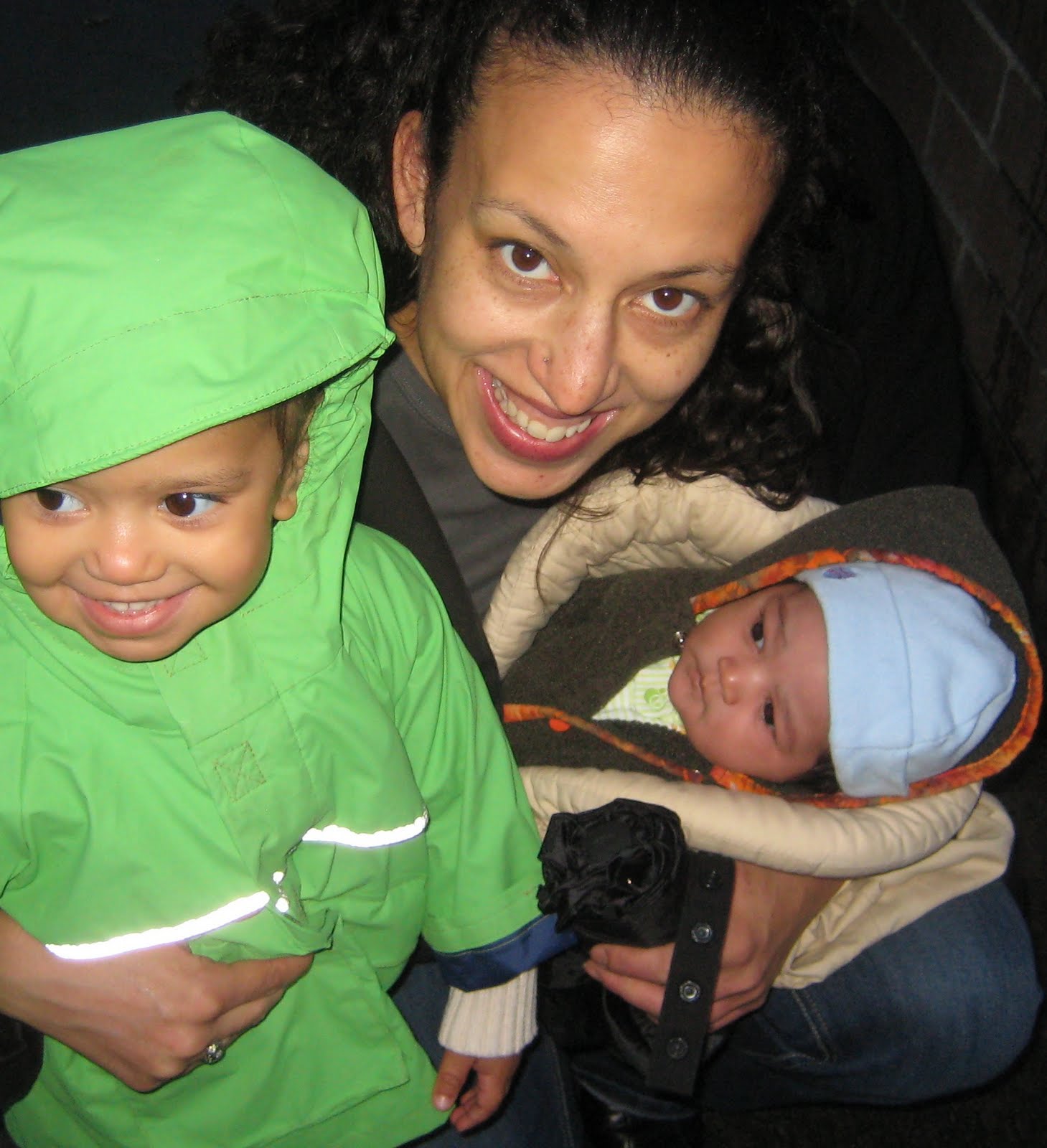
The picture of Carla with both children was taken shortly after her son, Quincy, was born while they headed to the International District to celebrate Lunar New Year.

Finally, the one of her, Adam and their daughter was taken while they were in transit.

Q: What's a nice multiethnic girl like you doing blogging about riding the bus?
A: Despite all of the stigmas that surround public transportation, buses are a writer’s dream. You have a vehicle filled with dozens of people—of all different ages, ethnicities, and life circumstances, with perhaps nothing more in common than the shared ride. It’s endless fodder for stories.
Of course, I don’t just write bus stories. I've found that I can use the bus as a jumping off point to talk about just about any subject, including my biracial identity. All it takes is a particular passenger, or incident.


Q: Tell us about your other writing.

A: I’ve written a novel—with a biracial protagonist, of course—which I’m probably not going to try to publish.  I’m also working on a nonfiction book called Rules of the Ride: The Transit Rider’s Bible. It’s a fun handbook for and about transit geeks in the tradition of the BAP Handbook/Hipster Handbook. My agent is currently working to find a publisher for it.
Q: Who are your parents, and how were you raised?

A: I’m a pretty standard Seattle mixed chick. My father is black (with some fairly significant Cherokee heritage), and my mother is white (of Irish, English, and Scottish descent). They married in 1966, while they were still students at the University of Oregon. I am the second of their four children.
My parents did not agree on how we should be raised to identify. Though my father never discouraged us from identifying as bi-/multi-racial, he believed that we would be viewed as black in the eyes of most people and, therefore, should be raised to identify that way. My mother felt that us being labeled black was simplistic and negated her contribution to our existence.
Growing up in Seattle in the 70’s and 80’s, I was exposed to lots of other biracial kids. My best friend (whom I’ve known since seventh grade) is biracial, and so were many of the children I played with as a young girl. Because of this, I never felt as isolated as other biracial people who come from other parts of the country or who were born before it became so common.

Q: Your husband is also mixed. Does that enhance your relationship?
A: In some ways, yes. I think we understand each other on a pretty fundamental level because we had similar upbringings. Both of us have a white mother and black father and were raised in middle-class homes and exposed to both sides of our families. (Did I mention that we’re also both left-handed, car-free transit geeks?)
That said, my husband, who was raised in Detroit, doesn’t identify as biracial or talk about it much. He doesn’t see a distinction between himself and other black Americans, most of whom also have at least some white ancestry.
For me, it’s not about making distinctions; it’s about being honest about who you are. I am very proud to be black (and often feel insulted when others don’t recognize me as such), but that’s not all I am. So, when I want to vent about (or celebrate) being biracial, I call my best friend or one of my many other biracial girlfriends.
Q: How has motherhood affected your view of multiethnic identity? How will your children be raised?
A: When my daughter was born, it felt redemptive in many ways. I had lost my mother earlier that year to cancer and was grateful to have another chance at a mother-daughter bond. Also, having grown up in a family where I didn’t “match” either of my parents, it was wonderful to have a child who had hair and skin just like mine. I still grin from ear to ear whenever someone says that she looks like me.
I have thought a lot about this issue—mostly about how I will teach them to deal with the inevitable “What are you?” interrogations—but haven’t really thought much about how I will raise my kids to identify. They will be free to identify themselves in whatever way feels most appropriate and comfortable for them.
Q: Why are you so passionate about public transportation?
A: I originally decided to ride the bus as my primary form of transportation out of concern for the environment (driving a car is probably the single worst environmental choice a person can make), but I’ve found it has almost innumerable benefits. I save tons of money; I can use my travel time to read, nap, or work; I get exercise every day without setting foot in a gym; and I have contact with my community that would never be possible in the isolated bubble of a car.
I have also come to realize that every value I have—some of these include: equality, frugality, environmental stewardship, compassion— can be reflected in my choice to use public transportation. I wrote an essay about it for This I Believe, which has an audio version I recorded at KUOW radio.
And the truth is, I really enjoy the ride. I love sitting next to my neighbors, being on the ground in my city. I love watching and listening—and learning about my fellow human beings.
People who drive everywhere don’t know what they’re missing.

Q: What does the future of transportation look like to you--flying cars as in The Jetsons?
A: I think the future of transportation is inextricably linked to the future of the built environment. You can have the most efficiently run, well-funded agency and the newest, best vehicle technology, but you won’t have good transit if you don’t have a dense, walkable, well-planned city that’s built to accommodate it.
So, I see the future of transportation as a fundamental change in how we build cities. Hopefully, by the time my children are grown, living without a car will no longer be seen as an alternative lifestyle.

The Bus Chick has spoken! Thank you, Carla for your futuristic insights.

Okay, Hip Hapa Homeez, here’s the usual spiel. News about blendies and mixies is still being posted on the Hip Hapa Homeez Group page on Facebook. Please join it and add your comments to some of the hundreds of links there. Everything begins with communication, and if we want to see a colorless future, we need to discuss with each other ways to work towards that goal. Our Watermelon Sushi Fan page supports our Watermelon Sushi film, so please sign up to “like” it on Facebook, as well. And, watermelonsushi is on Twitter with excerpts from the Watermelon Sushi script as well as recipe ideas for The Official Watermelon Sushi Cookbook. Follow us, and we’ll follow you! Last but, by no means, not least, buy a Hapa*Teez t-shirt and earn a rear-crawl credit on the Watermelon Sushi film. Your purchase not only helps forward our multi-culti agenda, but you'll be recognized for it, too!

Here's another plug to my girl, Teri LaFlesh, whose book Curly Like Me was released this week. Help me help her by buying a copy.


The future is always in front of us, so watch where you walk. As always, I am

Your Hip Hapa,
Yayoi

Wednesday, May 05, 2010

"Curly Like Me" In Da Houze! (And In Bookstores, Too!)

Hey, Hip Hapa Homeez! Welcome back to our world where we embrace your multiethnic selves, transracially adopted upbringings, and cross-cultural lifestyles. In fact, anything that represents your unique experience as a multi-culti or blendie-mixie is what we hold most dear.

Speaking of, one of my dearest friends and the first Facebook person I ever met in the flesh (pun intended) is also this week’s featured Hip Hapa Homee, Teri LaFlesh. Known by many women for her fabulous hair and valuable advice on how to make theirs look like hers, Teri is finally having her book (published by Wiley) on the market this week. 

Check out her links below then move on down to the Q&A. Be inspired by Teri’s “before” and “after” photos, too, and click the Amazon link to buy her book.


Q: What's a nice multiethnic girl like you doing writing a book about hair?

A: Actually, it was in large part due to my being mixed that ultimately inspired me to write this book about hair. I half grew up with my mom, who is black, and experienced how very curly hair is dealt with in many black communities--especially at the time I was growing up. Mostly, the choices were relaxers, hot combs, or the brand new Jheri curl. All the women on my mom’s side of the family relaxed their hair. So my hair was relaxed before I even knew it was curly. Since my hair is very fine, it fell apart under the lye-like chemicals, and became as stiff as fondant.

In my teenage years, I lived with my dad, who is white. We lived in a white neighborhood, his wife was white, and all my family on that side was white. Suddenly, I was left alone to care for my hair. It was a shock to me that it grew out curly. I had no idea what to do with it, and I tried to treat it like the hair of everyone around me (which was a disaster). So there I was, the only person of color in my entire vicinity, and I had this super-curly hair I had no idea what to do with. And, that curly hair that was like no one else’s hair began to symbolize how I felt about my place in the world at that time. I felt like an outsider, but an outsider who was let into the inside. I belonged, and yet I looked totally different from everyone I saw, so I felt I didn’t really belong. And, my crazy hair that puzzled and alarmed people around me seemed to be proof that I was different.

So, when I finally (finally!) figured out what my hair wanted (which was the hair equivalent of being loved and accepted for what it was, even if that was a bit different from everyone else), I wanted to make sure no other mixie girl with crazy curly hair like mine ever had to feel alone, or like there was something wrong with her because her hair seemed so different from either parent’s.

Q: How did you grow up?

A: I grew up in two environments that were polar opposites. I spent my early years with my mom, who is black. She was a public school art teacher (which meant we never had much money, and she was very creative), and lived in a black neighborhood. She was religious and lived in the south. I was surrounded by my outspoken family and lots of pets. Our place was always messy, and we ate junky food whenever we wanted. I went to a public school. We had few rules. I was bossy and the center of attention, and I mostly ran wild.

I spent my teenage years with my dad, who is white (as was his wife). He and his wife were computer programmers, so we had money. They were atheists. We lived in the northwest in an all-white town where I went to private schools. Our house was quiet and ordered and spotless, with no pets. We ate healthy food, but only at certain, previously arranged times. My life was run by rules. I was awkward and quiet, and very shy.

So I grew up not only between two races, I had two totally different childhoods, and lived as two different people with totally different personalities to fit those environments. But each environment taught me totally different and necessary skills I needed in life.

Q: Explain why you call yourself a "Former Mushroom Head Kid". 

A: In the transition from living with my mom to going to live with my dad, a hairdresser gave me a Jheri curl over the relaxer my mom already gave me. The hairdresser had told me and my mom that as the curl grew out, I would have little ringlets on the ends of my straight hair. This sounded really pretty. Then, I went to spend that summer with my dad. When my dad saw the greasy Jheri curl activator, he forbid me using it. So, I dry brushed my already damaged hair every day into a crunchy cloud, and patted it into a round shape, and waited for that straight hair to grow out with the ringlets on the ends. It never came because (to my surprise) my hair wasn’t straight. In fact, it was very curly. Instead, my now triply damaged hair got bigger and bigger until it turned into a mushroom shape (see photo). The sad thing is I thought that stiff, broken hair-cloud was what my natural hair was like, and it was a specter that haunted me for many years whenever I thought about possibly going natural.


Q: There's so much good, scientific information in your book. How long did it take you to write it?

A: Aw, thank you for saying that! I did a ton of research for it. I’d say the book took about two years to do. The first year, I wrote it in snatches of free time, such as when I was riding the train to and from work, and would type what I’d written when I got home. The second year I spent taking the pictures for the book, and researching and drawing the illustrations for it.

Actually, it took me about 30 years of trying to figure out what to do with my hair. I figured it out for selfish reasons: I wanted hair that wasn’t an ordeal, but was just hair and not a big deal. I had no intentions of writing a book. It was one day (after I’d figured out how to make my hair happy) that I realized I hardly thought about my hair any more, and it was down to my waist, and I was happy with it. It was then that I thought I might have found out some things others might really want to know, too (and may not want to have to struggle for 30 years to discover).

Q: Will there be a book tour?

A: At this time, there is a tiny tour planned, but I’ll probably mostly sign books in bookstores in my travels visiting relatives. I’ll be at the Mixed Roots Film and Literary Festival in June. Honestly, I’m pretty shy in real life, so I’m happy keeping things lower key. 

Q: What do you make of the current influx of published works by multiethnic people?

A: I think multiethnic people have had a very strong voice throughout time, however, they were often lending their voices to other fights, and their multiracial heritage was often downplayed, overlooked, or not acknowledged. Recently there has been an explosion of voices speaking as multiracial, and now refusing to be mashed into only one box. That’s very powerful and wonderful. I actually mark the turning point (for the media at large) as Tiger Woods, who helped put multiracial on the map. Often, when a race other-than-white is mixed with white, it seems to be the race of color that comes to dominate that person’s label to the world. Woods was one of the first celebrities I remember hearing about that wasn’t half white. Since he didn’t have a white parent (so he couldn’t just be lumped into the other-race-besides-white category), there wasn’t that neat default of placing him into the race of color as his automatic identity. Now people had to think about what he actually was for a moment: was he ‘Black’ or ‘Asian’ or ‘Something Else’? I think that not having an easy answer helped open many doors to the idea of being more than just one thing. Oooh. I hope that makes sense.

Q: What other writing projects do you have planned?

A: I’m working on a collection of short stories about my years running around as a wild child in the woods of Kentucky. I did some goofy things in those days, and was lucky enough to live in a home that let me get away with way more than I should have.

Congratulations, Teri! What an amazing author and humble Hip Hapa Homee, you are. btw, I love this quote from you: “When I made peace with my hair, I made peace with myself.”

Lately, Your Hip Hapa has been saving controversial clips (Sandra Bullock’s black baby, etc.) for the Hip Hapa Homeez Group page on Facebook. If you’d like to engage in a discussion, please join the group and leave your comments at any one of some 500 links posted there. Also, please sign up to “like” our Watermelon Sushi Fan page. Since Facebook has changed the rules, you no longer have to become a “fan”, but can just like us. You can also follow us on Twitter where we post dialogue from the Watermelon Sushi film script, and we promise to follow you back. Finally, show some love for the Watermelon Sushi film by checking out our Hapa*Teez t-shirts.

Until we meet again in our Watermelon Sushi World, I am

Your Hip Hapa,
Yayoi

Wednesday, April 21, 2010

Plate Lunch: Two Scoops Of Hapa

Aloha nui loa, Hip Hapa Homeez! As we say in Hawai’i, komo mai or welcome. He hale keia a (this is the house of) our multiethnic and cross-cultural agenda featuring folks we like to call da kine Hip Hapa Homeez.


This week’s featured Hip Hapa Homee is another Watermelon Sushi Associate Producer, Scott Lee, pictured above in mid-tea toast. Below, are photos of my fave dishes that Scott always orders for us at our preferred Waikiki eatery on Kapi’olani Boulevard. That’s cake noodle on top, and eggplant with tofu beneath it. Mmm. So ono da kine! No siree, no plate lunch here. If you’re hip, then you know the typical Hawai'ian plate lunch includes two scoops of white rice, or one of macaroni or potato salad.


Scott, who lives on Oahu where he’s a skillful chef, has been a reliable source for financial investment information for our independent film, Watermelon Sushi. If you have any ideas you’d like to discuss with Scott, do drop a line to yourhiphapa@me.com and we’ll forward your email to him.

Q: What makes you a Hip Hapa Homee?

A: I'm Chinese, Korean and Hawai’ian, which is considered a Poi Dog here in Hawai’i. Growing up in Honolulu in a working class family (that sacrificed to send me to private school in my early years only for me to end up in the secondary public system), I was exposed to both ends of the tracks. The multi-cultural culinary field in a predominately tourism economy allowed me exposure to the ‘rainbow’ diversity and, more importantly, acceptance of Hawai’i living as experienced by President Obama. I have lived here all my life visiting other states on occasion and, I look forward to experiencing more of what this planet has to offer.

Q: How did you grow up?

A: My parents were both educators and with it came all the bells and whistles of underachievement and accomplishments necessary for parental unit approval; more so the end result of my life working in the food industry. Personally, I don’t feel it matters what I do being that all the families with a long history here in Hawai’i descended from farm life in the pineapple and sugar cane fields.  

Q: What's your role in Watermelon Sushi?

A: To be honest, I really do not consciously know what my role is with Watermelon Sushi. Between all of you out there and me, I sometimes believe Yayoi keeps me around as a Hawai’ian pet in need of attention. Actually, for the past 15 years to mix up the sometimes "Groundhog Day" eventless mastery of my culinary career, I decided to experience some opportunistic activities in my spare time leading to a wealth of knowledge and useful contacts I believe will become assets to the production of Watermelon Sushi.

Q: What else do you do?

A: Paying the bills falls on my ability to food service particular working class clients who have had the chance to sample my 25 years experience in the hotels and restaurants of Oahu at "sub fast food prices".  When or if the economy improves anytime soon, I will be increasing my efforts in this arena.

Q: As a renowned chef, do you have a recipe to contribute to The Official Watermelon Sushi Cookbook?

A: Yes!  Mix your favorite b-b-q sauce with your favorite teriyaki sauce one part to one part and use it on everything; get rid of your favorite ketchup.  

Q: What impact do you think Obama's presidency has made on multiethnic agendas?

A: What! Are you kidding? It has everything to do with what our society has become culturally. I’m not talking about all the work the different ethnic backgrounds have produced in the last 50 years. I’m talking about forcing all the culturally ignorant individuals that were sitting on the fence deciding whether or not to accept publicly what they already knew in their hearts. Other than the few aliens roaming around lost on this planet, we are all 99.9% genetically the same. Just like all the doggy breeds, we have all the same genetics whether big, small, hairy, or not.

Q: Speaking of aliens, what do you see in Watermelon Sushi’s future?

A: Watermelon Sushi will kick start a revolution of all the people who have been looked down upon as being half-breeds in their perspective hometowns, in their home countries. It is now in the minority to be of only one cultural background.

Mahalo nui loa, Scott Lee! Moke shaka!

Remember, if you’re a Hip Hapa Homee with a story to share, email yourhiphapa@me.com so we can feature you here. Next up, look for our interview with author Teri LaFlesh discussing her book, Curly Like Me.

And, here are some updates from past Watermelon Sushi World interviewees:

Filmmaker Joe Doughrity’s Akira’s Hip Hop Shop


one of the finalists in BETs’ “Lens On Talent”--is now available through Amazon. 

Check it out here. You go, Joe!


Actor Tony (Juan Carlos) Insignares 

has a role in a film released on April 17 called The Harps

Here’s the link:


Finally, congratulations to iPrince, Richard Todd Smith, last week’s featured Hip Hapa Homee. iPrince has been hustling so hard on behalf of our Watermelon Sushi film that he earned a promotion to Co-Producer! Congrats, and big up. Please friend iPrince Smitty on Facebook or email him at iprincemsmitty@gmail.com with any questions you have about production. Since our interview last week, iPrince forwarded this photo below of Detroit’s Chinatown. What a Hip Hapa Homee!

Remember, if you’d like to show your support, purchase a Hapa*Teez 
t-shirt and earn a rear crawl credit on the film. Also, join our Hip Hapa Homeez Group page on Facebook to stay informed about all the news pertaining to multiethnic communities and transracial adoptees. Become a fan of our Watermelon Sushi Fan page on Facebook to be kept up-to-date about our film. You can also follow the Watermelon Sushi World blog on Facebook. And, if all of that’s not enough to show us love, follow watermelonsushi on Twitter. We promise to follow back!

That’s all she wrote for now, but I am and always will be

Your Hip Hapa,
Yayoi

Wednesday, April 07, 2010

iPrince: The Monarchy Of A Multi-Culti Mind


Welcome back to Watermelon Sushi World! Please enter the portal to our universe of mixed-ness where cultures cross and ethnicities blend. Kick back and make yourself at home, Hip Hapa Homeez.

This week, Your Hip Hapa profiles one of several Watermelon Sushi Associate Producers located around the globe. What’s a Watermelon Sushi Associate Producer? Watermelon Sushi is our feature film, which our Associate Producers are dedicated to producing and bringing to the silver screen for you. The worldly Mr. Richard Todd Smith, better known as iPrince, explains. Above is his face, below his thoughts.

Q: What makes you a Hip Hapa Homee?

A: I'm African American and live in the inner city of Detroit Michigan. We’re internationally known as the Motor City and where the Motown musical legends came from.

But last year in 2008, I lived in Phoenix where I worked with the Latino population. As a youth and community developer, I partnered with the downtown, centrally located, YMCA. I established youth enrichment programs, summer camp programs, basketball and soccer tournaments, swim teams, Friday night jams, and parties with local radio stations. The YMCA has different partnerships, like with Arizona State University. Youth At Risk is another organization that we worked with; and, also six local high schools and four elementary schools in the district. There were over 100 participants in our program.

Not only was I able to eat great Latino meals in Phoenix, but I also learned the culture of the population, which is centered on food and family. Besides the hot weather, I was also exposed to bilingual speaking and learned some Spanish. I ate hot tamales, quesadillas and soft tacos with sun-dried tomatoes and jalapenos all day long, as well as lots of fresh fruits—apples, oranges, bananas and plantains; a Latino staple.

Q: What's your role in the Watermelon Sushi film--past and future?

A: My thing is outreach. I enjoy reaching out to multiethnic communities and sharing with them even as I learn more about their histories. I’m interested in teaching others about cross-cultural agendas and mixed-race people, and the message and motivation of Watermelon Sushi. I plan to approach diverse cultures and expose them not only to the producers behind the film project, but the project itself. I want to inform younger generations, teenagers, and my peer group--the 30 somethings, the Gen Xers—and reach out to educate them about crossing cultures and what it means to be multiethnic. I want to speak to an international audience. This project is an international project, and I want to teach about it globally. 

As a project for this summer, I’m also working on sponsoring a basketball team to buy Hapa*Teez t-shirts which advertise and finance the Watermelon Sushi film. We’ll approach, say, a local grocery store and ask them to donate a number of shirts to our team. 10% of the funds raised will be donated to the film’s production. This will give us the spin of outreach. I want to sponsor those ball players and take photos of them to be part of the film. I'm looking forward to doing my part. I plan to showcase these types of activities to potential financiers, especially in an urban setting.

I’m also researching film credits, incentives and tax breaks offered by the Michigan Film Office. Soon, I’ll be contacting some key players in that organization to see how we can work together on Watermelon Sushi. To quote Joe Biden, this is a big blankety-blank deal!

Q: What else do you do?

A: I'm a part-time student at Wayne State University where I study urban development and political science. I also work in the field of fine art and antiques; primarily 20th Century American furniture. I also read a lot to stay informed; mostly magazines like Architectural Digest, Fine Wine, Forbes, and Your Hip Hapa’s cousin’s, Oprah's, publication—O.

Q: How did you grow up?

A: I was born and raised on the east side of Detroit. My family is middle-class and, as business owners, gave me the incentive to be entrepreneurial. My folks owned re-sell shops, a gas station and a local Dairy Queen. The majority of my time was spent being involved in after-school programs, and sports for exercise and staying healthy.

Growing up, I attended a private Catholic school, St. David, where we had mixed populations with both black and white roots. Any mixed-race students were predominantly black and white although some had Asian mothers and black fathers. In Detroit, we have a Chinatown, so our family would go there to eat out. We also have a Mexicantown and Africantown--where West Africans from Ghana display their dance culture.

Q: What impact do you think Obama's presidency has made on multiethnic agendas?

A: I don't think he’s made an impact directly, but indirectly by his image because those communities benefit from his having an image of color. By us having a multiethnic president, it sends a hopeful message to multiracial people of color.

Q: Do you have a recipe for The Official Watermelon Sushi Cookbook?

A: You better believe it! It's going to be my caveat to being a part of the project. I'm not much of a cook though. I have sisters, so I eat and wash the dishes. Yes, that sounds sexist, but we role-play. I stay in my lane and they stay in theirs. I'm a willing participant of it. Even if I cook, my sisters taste the food and are like, “Well…” And, then, they may not wash the dishes, so I'll be stuck washing dishes and cooking, too.

Having said that, I may consider submitting a recipe for a fruit salad with watermelons, cherries, strawberries and apple slices. And, I’ll use hummus and olives rolled in rice and seaweed for what I’ll call “Middle Eastern Sushi.” It sounds terrible, but it is catchy.

Q: What do you see in Watermelon Sushi’s future?

A: Not only will it be a film, but a brand--a household name. It will be in your library as a novel, in your kitchen as a cookbook, in your den on a DVD, in your child’s room as a paper doll, and even in your home as houseware like china and linens. It will be in all kinds of homes of all different races as a constant reminder of what it takes to work together in the world. We live to learn about each other so what is it going to take for us to exist together? I see Watermelon Sushi educating the world about the ways and principals of how to relate and understand other ethnic groups and other cultures. 

Wow! No wonder Watermelon Sushi is growing so successfully—thanks to Associate Producers like iPrince. btw, HAPA birthday, iPrince! (Friday, April 9)

To contact Richard Todd Smith:

Friend him on Facebook: http://www.facebook.com/iPrinceSmitty
Follow him on Twitter at http://twitter.com/mrtsmitty

Stay tuned, Hip Hapa Homeez, as we continue to present Watermelon Sushi Associate Producers from around the planet along with regular profiles in the coming weeks. We’ll also be developing The Official Watermelon Sushi Cookbook where your vegan recipes will be published along with your photo and story. For more info about the cookbook, email yourhiphapa@me.com

Now, here’s a shout-out to our Hapa*Teez supporters. Remember, if you make a purchase, contact us at hapateez@me.com for your rear crawl credit. This week’s featured Hip Hapa Homee in Hapa*Teez t-shirt is British beauty Sogba Bruce Jaja. Looking good, girl!


And, here’s an announcement from Andrew Grant-Thomas, Deputy Director of the Kirwan Institute for the Study of Race and Ethnicity (Ohio State University). Andrew is soliciting a wide range of views on the subject of future race relations and besides tapping advocates, researchers and other professionals, he’s also looking for “bloggers, poets, writers of speculative fiction, futurists, young and old, immigrants, poor and working class people of color and just plain folk.” Get more info at this link:


Speaking of Obama, this week’s featured Amazon product is Watermelon Sushi Associate Producer Pearl, Jr.’s on-demand video titled Barack Obama: The Power of Change.

Let’s end with a BIG UP to all you Hip Hapa Homeez Group members and Watermelon Sushi Fans on Facebook, and to you tweeting Twitterers. Anyone can join us, so please do. And, keep your comments and emails coming. Like iPrince, above, we love it when you reach out. Soon we’ll meet again, and until then, I am

Your Hip Hapa,
Yayoi

Wednesday, March 24, 2010

Blasian, Blackanese And Beautiful

Ni Hao, Hip Hapa Homeez! In case you’re not familiar, that’s “hello” in Mandarin. This week’s greeting is in honor of our featured Hip Hapa Homee, Kimberly Campbell, who has lived in China with her family. What’s so unusual about that, you may well ask? Well, Kim, her husband and two children are African Americans--which really shouldn’t be all that remarkable. Yet, most people still consider it significant when blacks live abroad, and we don’t mean in Africa or the Caribbean either.


That’s Kim with her Chinese students in the photo above and below, a spread of her family.

Q: Why China, Kim?

A: I’m a professor in the Communication Department at Texas Southern University, and am conducting interviews and holding meetings about ways to build bridges between African American and Asian American communities. I appreciate all the bridge builders who have been working towards that end for many years. Anyone who would like to connect, share resources, and/or exchange ideas should email me at kdctheory@msn.com 

Q: When did you first develop an interest in Asia?

A: As a child, I was interested in traveling and learning about various cultures. I recall being attracted to Asian philosophies, books, and films as a high school student. I do have some pretty early memories of connecting with Chinese stories and people as a very young child. I remember enjoying the Seven Chinese Brothers book, and recall enjoying the accent of a Chinese woman who worked at my pre-school. So, perhaps my attraction to Chinese culture was ignited early on. 

I also recall really enjoying Bollywood musicals and dance routines. Hopefully, I will get to visit India in the near future. I am definitely open to other cultures and find that learning about them is a great way to learn about myself. I love to share my Blasian stories!

Q: Did you or your husband grow up in multicultural environments?

A: My husband and I both grew up in predominately African American environments within Detroit. Both of us, even as young people, demonstrated an openness to people and friendships with persons of diverse backgrounds. Our parents were open to diversity in professional settings, but maintained almost exclusive African American personal friendships--at least while we were children. Nonetheless, once I became a teenager, I recall that my mother’s circle of friends became more inclusive of diverse persons and has continued that way today.   

Q: How long did your family stay in China?

A: From 2006 to 2008, we lived and worked in south China in a city called Shunde, about 25 miles south of Guangzhou and about an hour and a half north of Hong Kong. Our children are fluent in Chinese and are culturally Blasian, or Blackanese as some refer to them, in many ways.

Q: What did you do there?

A: My husband and I worked at a K-12 private international baccalaureate school. I worked with high school juniors and seniors teaching critical thinking and helping them prepare for admission to colleges/universities in the U.S., Canada, Europe and Australia. Teaching high-schoolers was new to me as my entire career before going to China had been teaching at the college level for about 13 years.

Q: And, your kids?

A: Our children attended the international school where we taught for the first year. The teachers in the lower grades spoke very little English so our children learned Mandarin quickly. After only five months, both children (7 and 9 when we arrived in China) were fluent! At the end of their first year, they were ranked 1st (daughter) and 2nd (son) in Mandarin speaking, reading, and writing out of about 200 foreign students. Our children often served as translators for my husband and me, and for other foreigners living in China.

Q: What was it like being black in Asia?

A: I was the first African American woman, or woman of African descent period, to have worked/taught at the school. There was another African American man from Texas who started teaching there when my husband and I did, so my husband was one of the first African American men to teach at the school. After two years, the school made very generous offers for us to stay. After we left, the school recruited five African Americans to teach there. We really feel we were trailblazers and cultural ambassadors for the school!

Q: Did you visit other Asian countries?

A: Over the two years, we had the opportunity to travel to Thailand, Philippines and throughout China. The exposure was quite enriching for our family. It was very rare to see other African Americans--especially ones traveling with a family. We wouldn't trade the experience for anything. We will always remain connected to Asian culture.

Q: What did you guys eat? 


A: The food in southern China was definitely different from the taste and style of Chinese food served in U.S. restaurants such as Panda Express. What an adjustment!  As we traveled to different parts of China, we became more knowledgeable about the diverse food and cooking traditions in those places. Lamain noodles--a long stretchy noodle from Islamic Chinese areas of Western China--were one of my family's favorite foods.

Q: What are you doing now?

A: I have returned to academia and currently serve as Interim Chair of the Speech Communication Department at Texas Southern University. My husband has started an ESL company in Houston.

I am involved in several research projects and am developing an organization designed to identify opportunities and overcome challenges in strengthening African American and Asian American relationships. Some of the projects also seek to uncover key differences in communication styles that may present cultural blocks for the two groups. By the way, I’m brainstorming ideas for a name for the organization I’m starting if anyone has any suggestions. Also, I'm writing about African American families living abroad, and at least three of the families reflect on their experiences living in Asian countries.

Q: What about your children?

A: The children attend an international baccalaureate school in Houston, and study Chinese at their school.

Xie xie, Kim! (That’s pronounced sheh sheh and means thank you.)

Now for some announcements:

Hip Hapa Homee Vanessa Chong is working on a Biracial Identity and Family Study for those who are half Asian and half Caucasian. This is a part of the University of Windsor’s multicultural research program in the Department of Psychology. You must be between 18 and 30, and live in the U.S. or Canada to participate. As a token of appreciation, participants will be entered in a drawing for $25 gift cards. The website link is  
http://uwindsor.ca/biracial and requires using “biracial” as your ID and “survey” as your password. For more info, contact Vanessa at brstudy@uwindsor.ca

And, Hip Hapa Homee Michelle Hughes sent us info about the 2010 Census and why it’s important for those of us identifying as being more than one race to complete the form. For more info, visit http://2010.census.gov or contact 2010 Census National Partner, Association of MultiEthnic Americans (Jungmiwha Bullock or Harold Gates ), at 818-230-2285 or amea2010census@gmail.com

Remember, your purchase of a Hapa*Teez t-shirt will help support our Watermelon Sushi film while earning you a rear crawl credit. You can also join our Hip Hapa Homeez Group page on Facebook, where we post the latest news for blendies, mixies and transracial adoptees, and our Watermelon Sushi Fan page where we keep you updated about the film. In the next few weeks, we’ll be profiling Watermelon Sushi Associate Producers on this blog, so keep coming back. You can also follow watermelonsushi on Twitter where we post excerpts from the film script.

If you're looking for a good book to read, check out my friend Nashieqa Washington's cleverly titled Why Do Black People Love Fried Chicken? Obviously, Nashieqa's never eaten lamain noodles. Nevertheless, buy her book. You won't be disappointed.

Finally, here’s a shout-out to all you Hip Hapa Homeez for your continuing loyalty. It’s so heartwarming to watch our numbers growing every day especially when so many of you are not mixed-race, a transracial adoptee, or even in an interracial relationship. The fact that you still champion the cause for those of us claiming our multi-ethnic heritages speaks volumes about your spirit.

Until we meet again, I remain

Your Hip Hapa,
Yayoi